
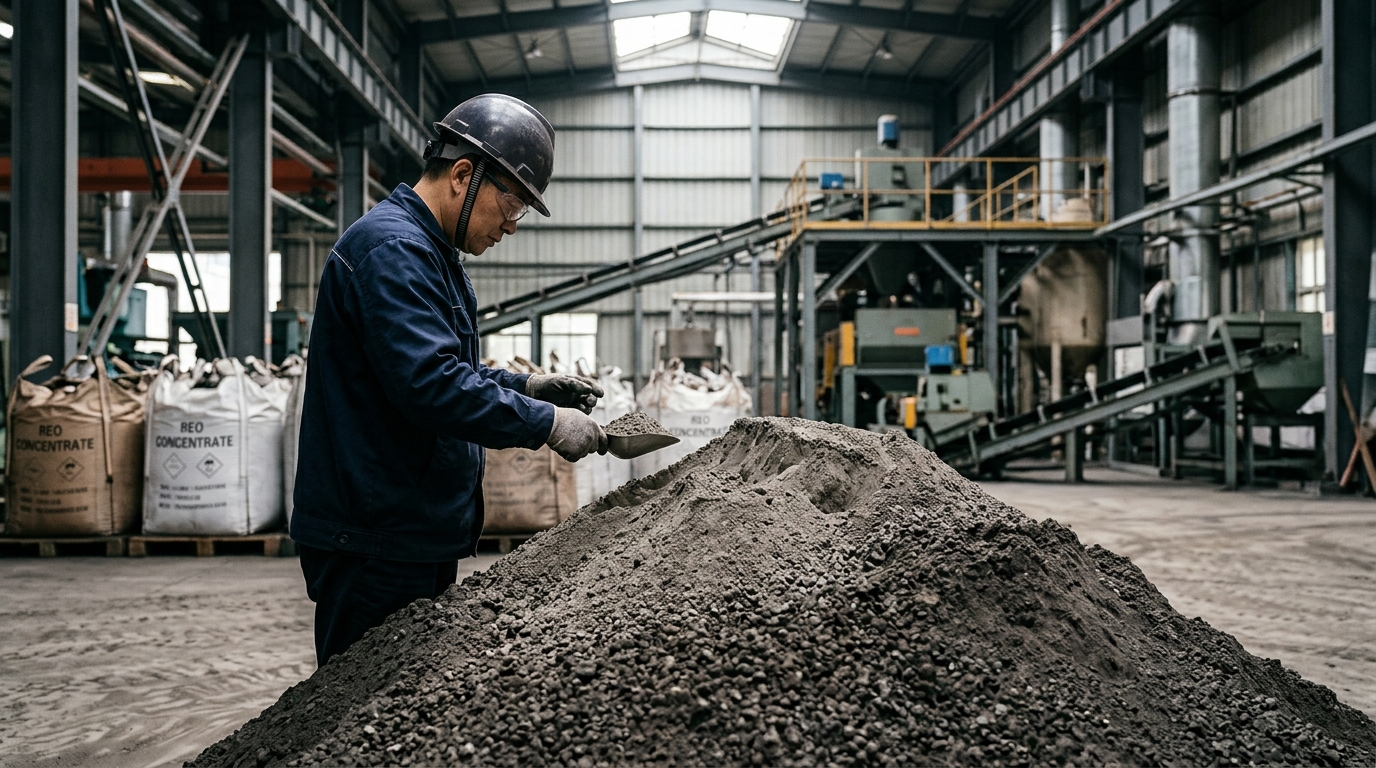
The question landing on every supply-chain desk this Monday is not whether China will embargo rare earths on November 10. It almost certainly will not. The question is whether Beijing will let the suspension lapse on purpose and use the resulting legal ambiguity as a licensing lever, one that extracts concessions from chipmakers, automakers, and defense contractors one application at a time.
On November 7, 2025, China’s Ministry of Commerce and the General Administration of Customs issued a one-year suspension of several export-control measures announced in October, with the suspension running through November 10, 2026. That package included controls covering rare-earth-related equipment and materials, and it included export licensing controls tied to five medium and heavy rare earths (reporting at the time highlighted holmium among the covered elements). The broader point stands: what expires Tuesday is not “rare earths” in general, but a time-limited suspension layered on top of an already complex control stack.
The legal picture is genuinely murky. Reporting in late 2025 described the suspension as lasting through November 10, 2026. Separate U.S.-China de-escalation extensions have been discussed publicly since then, but if Beijing does not renew the suspension in a formal, numbered notice, the suspension ends on November 10, 2026 on the calendar. That gap between a political statement and a published legal text is precisely where Beijing applies pressure.
The Bull Case for MP and Lynas
Investors who own MP Materials and Lynas on a pure supply-disruption thesis are probably holding the right stocks for the wrong reason. China’s potential export restriction does not fundamentally change the story for domestic rare earth miners. While the two sides could extend the truce, China’s export controls are structurally bullish for domestically based rare earth miners in the long term.
MP’s position is better protected than the share price debate implies. The Department of Defense entered a 10-year agreement establishing a price floor of $110 per kilogram for MP’s NdPr, reducing vulnerability to non-market forces and aiming to stabilize cash flows. Contemporary analysis of that agreement described the $110/kg level as nearly double the then-current market price. Even if Beijing floods the market with cheap oxides to undercut Western projects, MP’s economics have an unusual backstop through the term of that agreement.
The Pentagon has also backed Lynas as a key non-Chinese supplier, but the framing needs to be tighter. Lynas is widely described as the only significant producer of separated rare earth materials outside China, and Malaysia has become an important processing hub. Still, it is not accurate to state flatly that Lynas is the only company outside China that refines heavy rare earths at commercial scale, because other non-Chinese separations capacity exists and some companies separate mixed rare earths into individual oxides outside China. The investable takeaway is unchanged: Lynas remains a central, scarce non-China option for separated material, and its Malaysian processing footprint is strategically important.
The Bear Case: Priced for a Crisis That May Never Arrive
The risk for both stocks is not that the controls bite immediately. It is that they are being priced as crisis beneficiaries when the more likely scenario is managed access: Beijing issues licenses selectively, keeps global supply flowing at a controlled rate, and denies the sharp disruption that would justify current valuations. Reuters reporting on Chinese customs data showed rare earth magnet shipments to the United States fell 28.7% in September versus August, even as exports to Vietnam jumped 57.5%. That routing shift suggests Beijing is already directing flows, not cutting them.
What Investors Are Missing
The more consequential deadline is not Tuesday. From January 1, 2027, expanded U.S. defense sourcing restrictions on certain permanent magnets are scheduled to take effect through DFARS 225.7018, including supply-chain coverage for samarium-cobalt magnets. American manufacturers face two separate timelines: a possible tightening of Chinese export controls in November and stricter domestic sourcing requirements in January. That second deadline forces Lockheed Martin and the broader defense supply chain to certify compliant sourcing regardless of what Beijing decides this week.
Claims about a specific percentage hit to F-35 deliveries tied to a particular “2025 rare earth licensing regime,” attributed to Ti22 Strategies, could not be verified in primary, citable materials. The core logic remains: defense platforms with qualified-magnet requirements are exposed if supply tightens before compliant alternatives are certified for use.
That gap is the real trade here. Beijing’s decision this week to block SoftBank’s roughly $5.4 billion purchase of ABB’s robotics division, as reported by Bloomberg, underscored that China’s regulators are willing to use approval power aggressively around sensitive industrial transactions. A licensing squeeze, not an embargo, keeps Beijing’s options open and the pressure maximum.
Stocks to Watch
MP Materials (NYSE: MP) is structurally protected by its DoD price floor but trades at a forward price-to-sales multiple that already prices in a prolonged supply crisis. Watch for whether Beijing’s silence on renewal triggers further momentum buying that outruns the fundamentals.
Lynas Rare Earths (ASX: LYC) remains a critical non-China supplier of separated rare earth materials, which makes it hard to replace in the near term for defense-linked customers. Its Malaysian processing facility is a single point of failure worth monitoring.
Lockheed Martin (NYSE: LMT) carries the most acute exposure among named primes. The DFARS 2027 sourcing timeline puts it squarely inside a vulnerability window regardless of Tuesday’s outcome.
Tesla (NASDAQ: TSLA) discussed export licensing exposure for rare earth magnets affecting Optimus-related components on its Q1 2025 earnings call. Any reimposition of stricter extraterritorial rules would likely hit robotics programs that rely on constrained magnet supply chains.
ASML (NASDAQ: ASML) sits at the intersection of two risks: chipmaker customers facing licensing exposure and its own equipment containing processed rare earth components. If the suspended extraterritorial reach returns, ASML’s supply chain faces a compliance burden that European peers without its scale cannot easily absorb.