
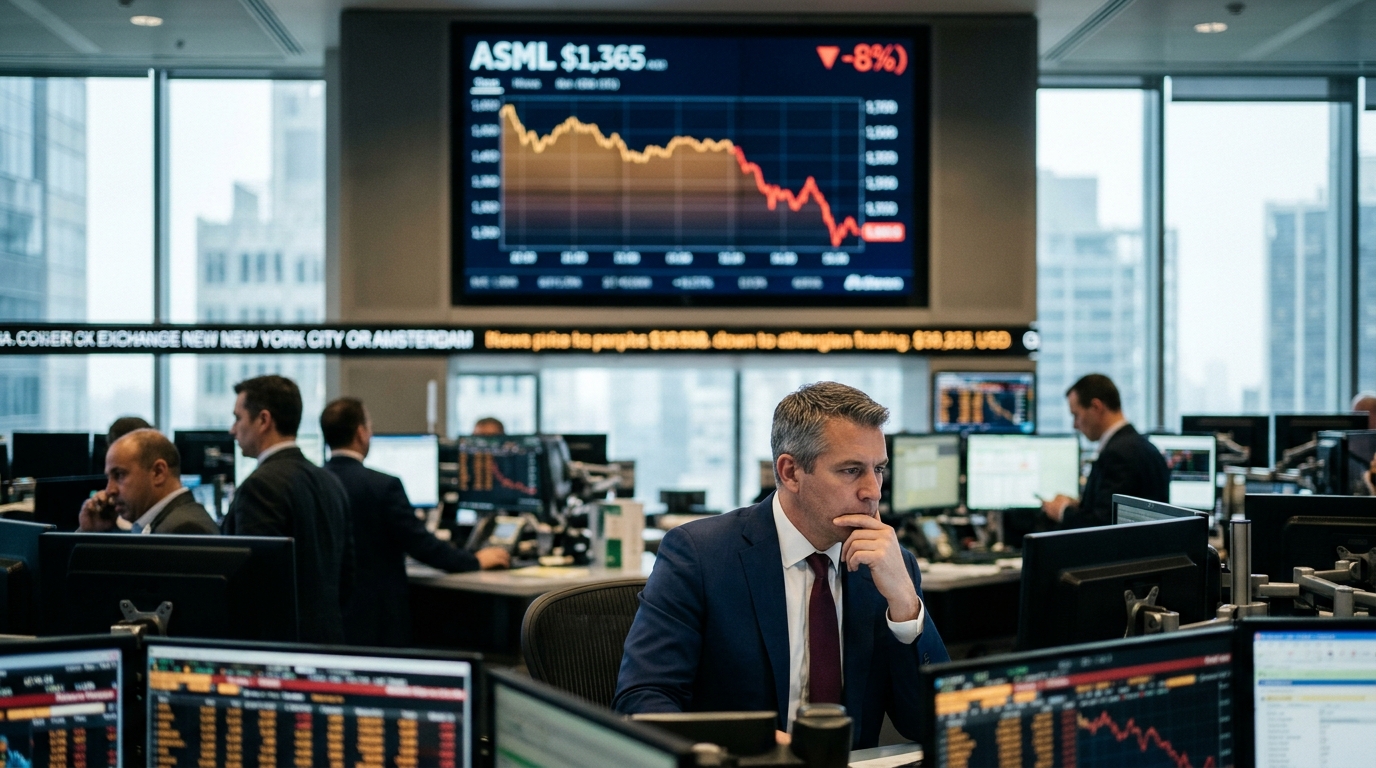
ASML is trading near $1,365 this morning, down roughly 8.8% as the Philadelphia Semiconductor Index posts its steepest single-session loss in months. The trigger is political: Democrats swept both chambers of Congress overnight, stoking fears of tighter AI regulation and potential moratoriums on new data-center construction. The fear is real. The sell-off, applied to ASML specifically, is worth interrogating.
- ASML down ~8.8% intraday to ~$1,365; Philadelphia Semiconductor Index off ~9%
- Forward P/E compressed to approximately 23x on FY2027 EPS estimate of $62.54
- Q3 2026 net sales: record €11.7 billion, up 55% year-over-year
- Q3 gross margin: 57.5%, above the 55–57% guidance range
- Full-year 2026 guidance: €44–45 billion in revenue, ~56% gross margin
- Demand visibility remains strong through at least 2028, based on management commentary around capacity and customer demand
- 41 analysts rate ASML a Strong Buy; consensus 12-month price target near $2,156
What the Quarter Actually Said
Three weeks ago, ASML reported numbers that had nothing to do with today’s selling. Net sales hit €11.7 billion in Q3, up 25% from Q2 and 55% from the same quarter a year ago. Gross margin for the quarter came in above guidance at 57.5%, driven by an exceptionally high-margin mix within the installed-base management business. Net income reached €5.0 billion, more than doubling the prior-year quarter. Management updated full-year guidance to €44–45 billion in revenue with gross margin around 56%.
The demand picture is the more important signal. Despite market concerns about a semiconductor downturn, management has said customer demand exceeds supply capacity through 2028, and the company is executing a significant capacity ramp. In particular, ASML has said it intends to increase immersion-system capacity by 30% in 2027, with work underway on potential additional expansion in 2028. That is the kind of multi-year operational ramp an election does not cancel.
The Real Risk, Sized Correctly
The legitimate concern is China. Management has indicated China will be approximately 20% of total net sales for 2026, and persistent U.S.-China export-control friction remains a background risk. Additional tightening in Dutch export licensing could pressure DUV immersion shipments and services to Chinese customers, and that would matter because China has been a meaningful end market for ASML over the last several years.
What it is not: a reason to overhaul the entire franchise. ASML remains the sole supplier of EUV lithography tools used for leading-edge manufacturing, and it retains structural pricing power because there is no substitute for those systems in high-volume, sub-7nm-class production.
Technical Framework
The stock has been trading below its 50-day moving average, which sits near $1,696. Today’s move extends that gap sharply. At $1,365, ASML is approaching the lower boundary of its 52-week range. Volume today will be the tell: if sellers exhaust on elevated volume near the $1,340–1,365 band, that zone becomes the reference for any recovery attempt. The 200-day moving average, well above current levels, is the ceiling to monitor on any bounce.
Scenario Framework
Bull case: AI-infrastructure spending continues at the hyperscaler level regardless of congressional composition, China DUV exposure is managed within guidance bandwidth, and 2027 EPS of $62.54 supports a re-rate toward 30x, implying a price near $1,875.
Base case: Export controls bite at the margin but do not expand materially beyond current DUV restrictions. ASML trades between $1,400 and $1,650 as the market weighs policy risk against record demand visibility.
Bear case: Congress advances meaningful AI-infrastructure restrictions, China DUV sales are curtailed further, and revenue outlook for 2027 is cut. At 20x on a reduced earnings estimate, support breaks below $1,200.
Trader Considerations
The question is not whether ASML is a structurally superior business. Earnings are expected to grow from $46.54 per share to $62.54 per share in the next fiscal year, a 34% increase. At 23x, that growth costs less than it has in years. The question is timing: policy fear can keep multiple compression alive for weeks. Traders watching this name should define their exposure against the $1,340 level as the near-term line of consequence, with position sizing calibrated to the volatility the election catalyst has already demonstrated. Preparation matters far more than conviction here.