
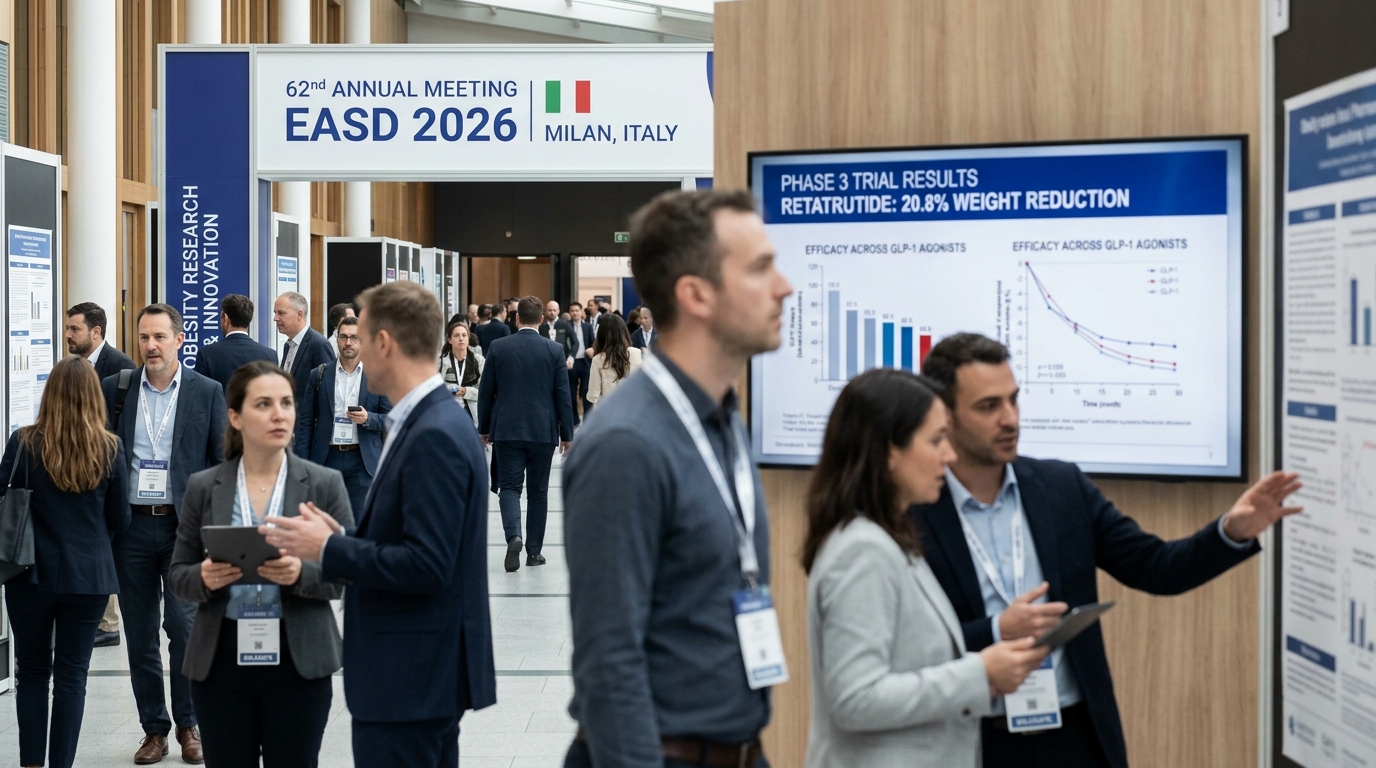
Milan’s Allianz MiCo conference center is hosting the 62nd annual meeting of the European Association for the Study of Diabetes this week, and the presentations landing between today and October 2 carry real strategic weight. This is not a routine data dump. For Eli Lilly and Novo Nordisk, the next several days decide whether the pipeline advantage that Lilly has built since Zepbound’s November 2023 FDA approval is durable across a decade, or whether Novo can close the gap before the market scales to the $100 billion level many analysts expect by the 2030s.
Lilly’s centerpiece is retatrutide, an investigational once-weekly triple receptor agonist that hits GIP, GLP-1, and glucagon simultaneously. Phase 3 TRIUMPH-2 results show adults with obesity or overweight and type 2 diabetes lost an average of up to 49.6 lbs (20.8%) and reduced A1C by up to 1.6% at 80 weeks. That number matters for a specific reason: semaglutide targets one receptor and tirzepatide targets two, and early retatrutide readouts have been among the largest weight-loss effects reported in obesity drug trials to date. Lilly is not incrementally improving on Zepbound. It is trying to build a higher-efficacy tier above it.
Lilly says it now has five positive Phase 3 studies supporting retatrutide, and has set a concrete timeline, targeting a Biologics License Application to the FDA in the first quarter of 2027. The full TRIUMPH-2 dataset gets its EASD stage time on Wednesday, September 30.
Alongside retatrutide, Lilly is putting two other molecules in front of the scientific community this week. Phase 3 ACHIEVE-4 data for Foundayo (orforglipron) will also be presented, with hazard ratios of 0.84 for MACE-4 and 0.77 for MACE-3 versus insulin glargine. Foundayo is Lilly’s oral GLP-1, and cardiovascular evidence in type 2 diabetes is exactly the kind of durable moat that keeps patients on a drug for years. Then there is eloraTZP, a combination of eloralintide and tirzepatide. Earlier Phase 1 results showed that eloralintide 3 mg added to tirzepatide 5 mg produced 17% weight loss over 16 weeks, compared with 10% with tirzepatide 5 mg alone. Phase 2 data arrives this week.
Novo’s answer is not nothing. The company says a total of 44 abstracts will be presented, including data across semaglutide, CagriSema, and zenagamtide. Real-world evidence from the OCTANE study will provide insights into Wegovy pill use in adults with overweight or obesity, including weight outcomes, treatment switching and patient-reported outcomes, while CagriSema and amylin-based pipeline data will provide new insights into appetite regulation, eating behaviour, food noise, body composition and bone health. The fMRI work exploring how CagriSema changes brain responses to food cues is genuinely novel science, addressing a patient complaint that has nagged at GLP-1 therapy since the beginning: the mental experience of hunger, not just its physical consequence.
The competitive reality is that Novo must argue quality of effect while Lilly holds the quantity argument. Saying Zepbound has already overtaken Wegovy to become the biggest-selling obesity treatment in the world depends on which geography and time period you mean, and it is not a clean, universally settled claim. What is clear is that tirzepatide has rapidly become one of the largest global incretin franchises. And while CagriSema’s weight loss and blood-sugar reductions have not been tested head-to-head against Zepbound in obesity, a direct comparison has not been completed yet. CagriSema is Novo’s best near-term answer, but retatrutide has not even launched.
For long-term investors, the question is not who wins this week’s conference. It is whether Lilly’s pipeline depth, spanning an oral pill, a best-in-class injectable, a next-generation triple agonist, and now an amylin-combination, is wide enough to hold pricing power and prescription share as the category matures. Lilly’s cardiometabolic strategy is a two-track bet: defend its existing tirzepatide and orforglipron franchises on convenience and established efficacy, while positioning retatrutide as the higher-efficacy option for patients who need more aggressive intervention against obesity’s most serious downstream complications. That is a coherent compounding strategy. Milan this week is where the evidence either deepens that case or complicates it.