
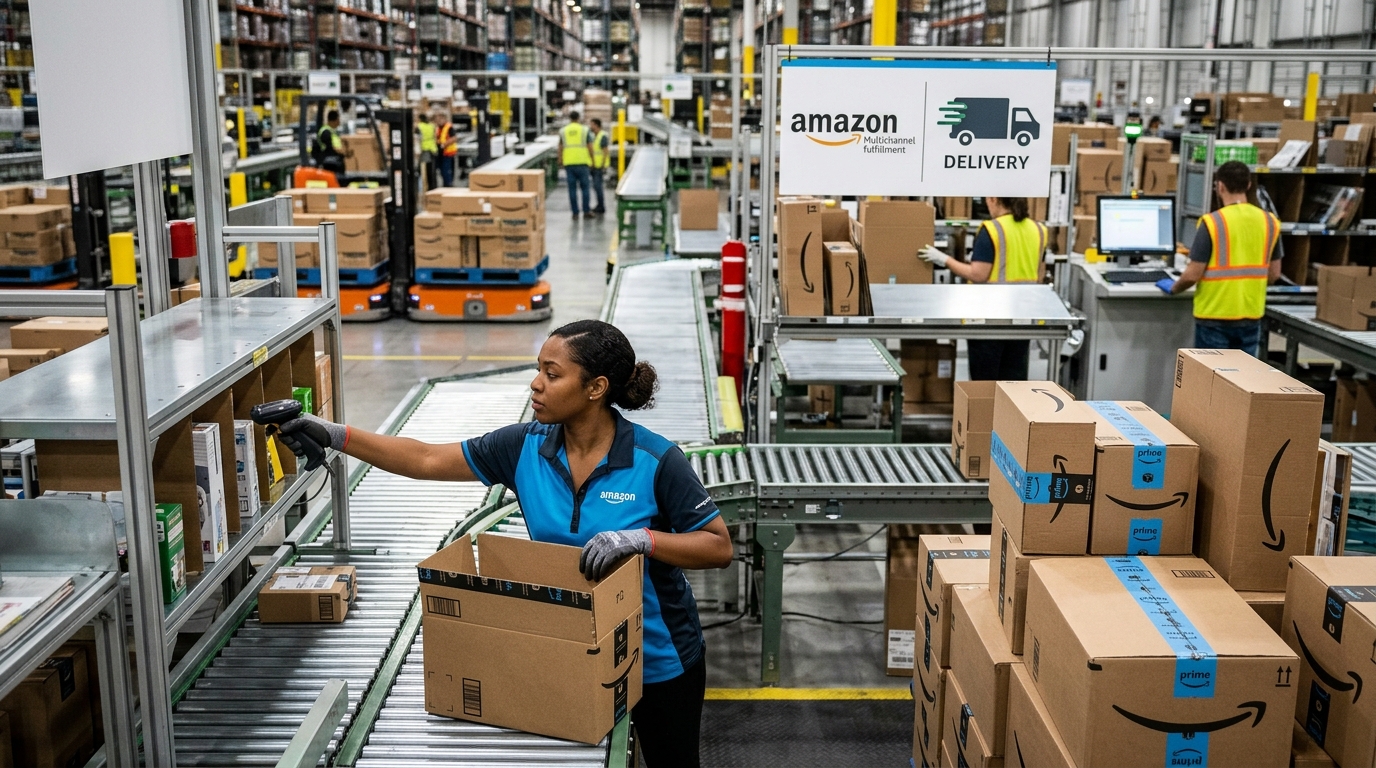
Amazon made two significant moves in a single week, and together they tell a coherent story about where the company is taking its logistics empire. On September 24, Amazon announced that merchants using its Multichannel Fulfillment service can now add the Prime badge and fast, free Prime delivery to their own websites at no additional cost. Separately, Amazon launched the MCF Preferred Pricing Program, allowing eligible sellers to save up to 15% on MCF fulfillment fees and earn up to $1 in FBA credits per MCF unit shipped.
The mechanism matters. The program combines a discount on MCF fulfillment fees with FBA credits on each unit shipped, with savings generally described by Amazon as up to 15% on MCF fulfillment fees plus up to $1 in FBA credits per unit shipped. There are no long-term contracts, and discounts are applied automatically after enrollment. Early adoption is already meaningful: among early merchant adopters, more than 40% of eligible orders on average have shipped with Prime delivery.
What Amazon Is Really Doing
The move is part of Amazon’s broader push to turn its logistics infrastructure into a service for other businesses. That framing is correct but incomplete. Amazon is also commoditizing the one thing Shopify has always sold as a premium: the ability for a merchant to own their storefront, their checkout, and their customer relationship, without ceding those to Amazon’s marketplace.
Until now, a brand building on Shopify could tell its customers: we ship fast, but we are not Amazon. That distinction is harder to sustain when the Prime badge appears on a non-Amazon checkout page backed by Amazon’s fulfillment network. Shoppers still check out on the merchant’s website, but Prime-branded delivery options can be embedded in the merchant checkout experience and may include Amazon-linked shopper flows depending on the implementation. Either way, Amazon gains the logistics dependency and the data trail that comes with it.
The same week, Amazon blocked Meta’s Muse AI agent from making purchases on its site, escalating a dispute between the two companies over who controls the online shopping experience when AI acts on a customer’s behalf. Blocking Muse while simultaneously extending Prime delivery off-platform is a deliberate posture: Amazon will not let rivals intermediate its checkout, but it will gladly intermediate everyone else’s.
The Shopify Question
In the second quarter of 2026, Shopify’s Merchant Solutions revenues increased 37%, compared with 22% growth in Subscription Solutions. That top-line momentum is real. The concern is structural. Shopify’s pitch to merchants has always rested on two pillars: software freedom and competitive logistics. Amazon is now pricing aggressively into the second pillar while keeping merchants technically independent.
Valuation remains a key concern for SHOP; the stock trades at a premium to both the broader industry and major peers, leaving little room for operational missteps or slower-than-expected growth. If Amazon’s fee discounts pull even a meaningful fraction of Shopify’s merchant base toward MCF fulfillment, Shopify’s Merchant Solutions gross margin, already under pressure from payment processing costs, faces another headwind.
Amazon also committed an additional $1.9 billion to its Delivery Service Partner program that same week, deepening the physical network that underpins these off-platform promises. That is not a program Amazon can replicate quickly; it is the result of eight years of capital deployment.
What Long-Term Holders Should Watch
For AMZN shareholders, the thesis is straightforward: logistics as a platform generates recurring revenue and builds switching costs across thousands of merchants who become dependent on Amazon’s network whether or not they sell on Amazon.com. The risk is antitrust. Amazon faces intense global competition and significant regulatory scrutiny, and the company is involved in multiple antitrust matters and investigations touching parts of its marketplace, advertising, and delivery ecosystem. Extending Prime delivery to rival storefronts will attract additional regulatory attention.
For SHOP shareholders, the question is whether Shopify’s aggressive investment in agentic commerce and Sidekick matures fast enough to reanchor the value proposition on software and AI rather than logistics parity. If merchants can get Prime-quality delivery through Amazon and best-in-class software through Shopify, the two businesses could coexist. If Amazon’s logistics pricing makes MCF the obvious fulfillment default for Shopify merchants, Shopify’s attach rate on its own logistics products weakens.
The single most durable lesson here: platform companies rarely win by defending their current perimeter. Amazon is redrawing the map of where Prime lives. Shopify’s response, not this week’s announcements, will determine which stock rewards patience.