
Monday delivered the cleanest sector rotation of 2026. The Philadelphia Semiconductor Index fell 5.9%. Capital did not leave technology. It moved specifically into enterprise software: ServiceNow surged 6.4%, Adobe gained 4%, and Salesforce added about 4.7%. The iShares software ETF IGV rose about 2.5% while the Invesco QQQ fell less than 1%, framing the session as a rotation inside technology rather than a broad bounce.
The trigger was a weekend essay from Anthropic CEO Dario Amodei calling on frontier AI labs to slow model development. That commentary is being read two ways at once: as relief for enterprise software vendors AI was supposed to displace, and as pressure on chipmakers and AI infrastructure names carrying the heaviest AI-buildout expectations. The beneficiaries were the exact companies the market spent most of 2025 and early 2026 selling on disruption fears.
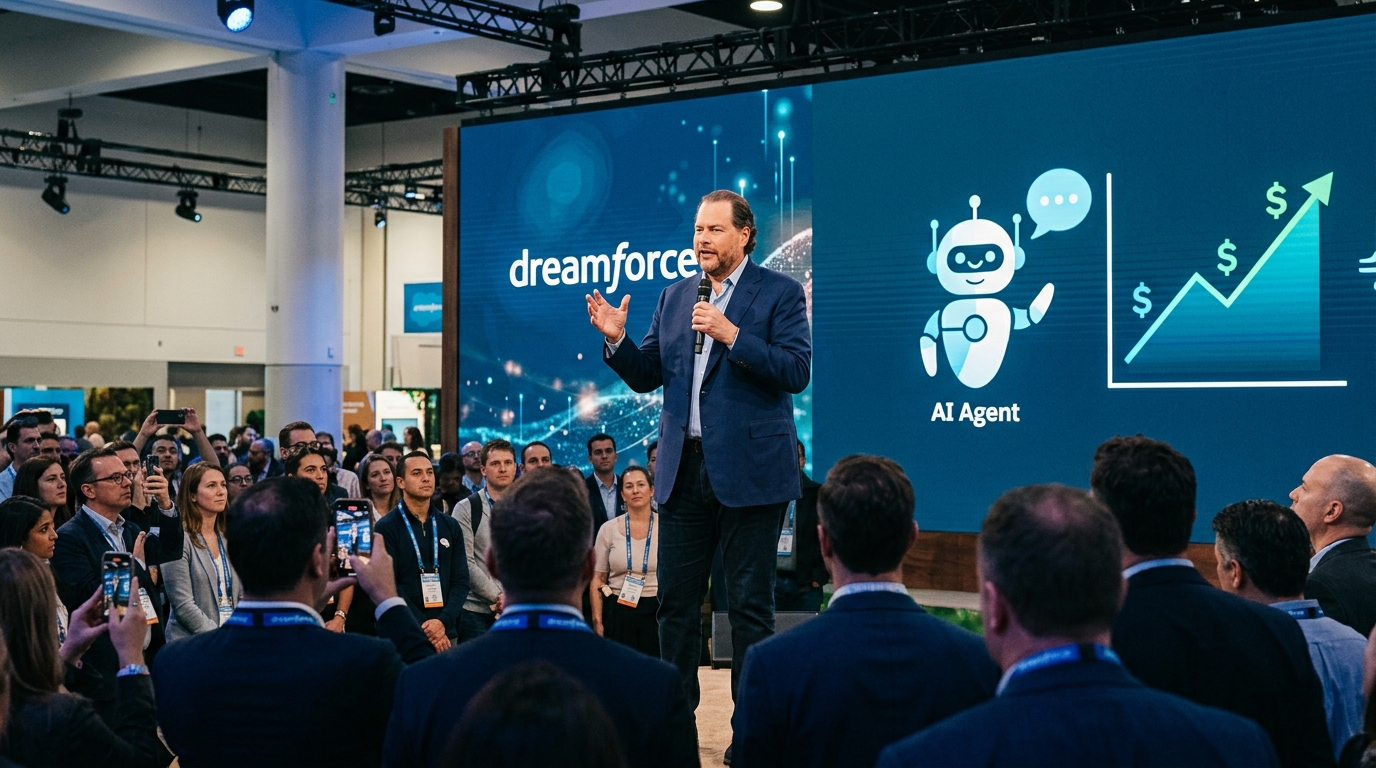
Which brings us to today. Benioff sits down with Sam Altman on stage at Dreamforce at 2 PM PDT, and the conversation carries more weight than any typical keynote. Two years ago, Salesforce used the Dreamforce stage to introduce Agentforce, the idea that AI shouldn’t just assist inside your CRM but should act. This September, that idea gets its biggest test yet.
The central question is not whether Agentforce is growing. It clearly is. Salesforce posted $11.35 billion in quarterly revenue and said Agentforce annual recurring revenue passed $1.5 billion, up more than 240%, undercutting the argument that AI agents would erode seat-based software. But the skeptics have not gone away. The bear case has been simple and scary: Salesforce built a $30 billion-plus machine selling one seat per human. If AI agents do the work of those humans, companies need fewer seats, and revenue shrinks.
The early data cuts against that fear. More than 50% of new Agentforce bookings as well as 50% of Data 360 bookings came from existing customers expanding their investment. Existing accounts are buying agents on top of their seats, not swapping seats out for agents. That is wallet expansion, not seat compression. Still, investors are increasingly questioning how AI agents could reshape enterprises, particularly for larger vendors that still heavily rely on seat-based licensing and cloud expansion growth.
Benioff’s answer at Dreamforce needs to be concrete. After two years of launches, demos, name changes, and AI-heavy keynotes, another perfectly polished Agentforce demo probably isn’t going to win over any skeptics. The audience, both in Moscone Center and in the market, wants proof at scale. Salesforce has signaled that customer stories will be a major part of Dreamforce 2026, giving buyers a way to assess how organizations are applying agentic AI, CRM, data, and collaboration technology in production. That choice of emphasis is deliberate.
Monday’s rotation gave CRM a gift. The stock spent much of 2026 trading well below prior highs as disruption fears outweighed reported results. One session does not reverse that. A Fed rate decision later this week could determine whether the software-semiconductor split holds. Higher yields would compress software multiples exactly when the group is trying to reclaim them.
The case for CRM today rests on the Agentforce ARR trajectory, the evidence that agent deals expand rather than replace existing contracts, and the symbolic weight of Altman sharing a stage with Benioff hours after the market voted for exactly this thesis. The risk is that any gap between the keynote and verifiable customer revenue numbers gets read as confirmation of the original concern: that the agent story is mostly marketing. Benioff knows the stakes. The question is whether the numbers he brings to that stage are enough to hold the bid that arrived a day early.