
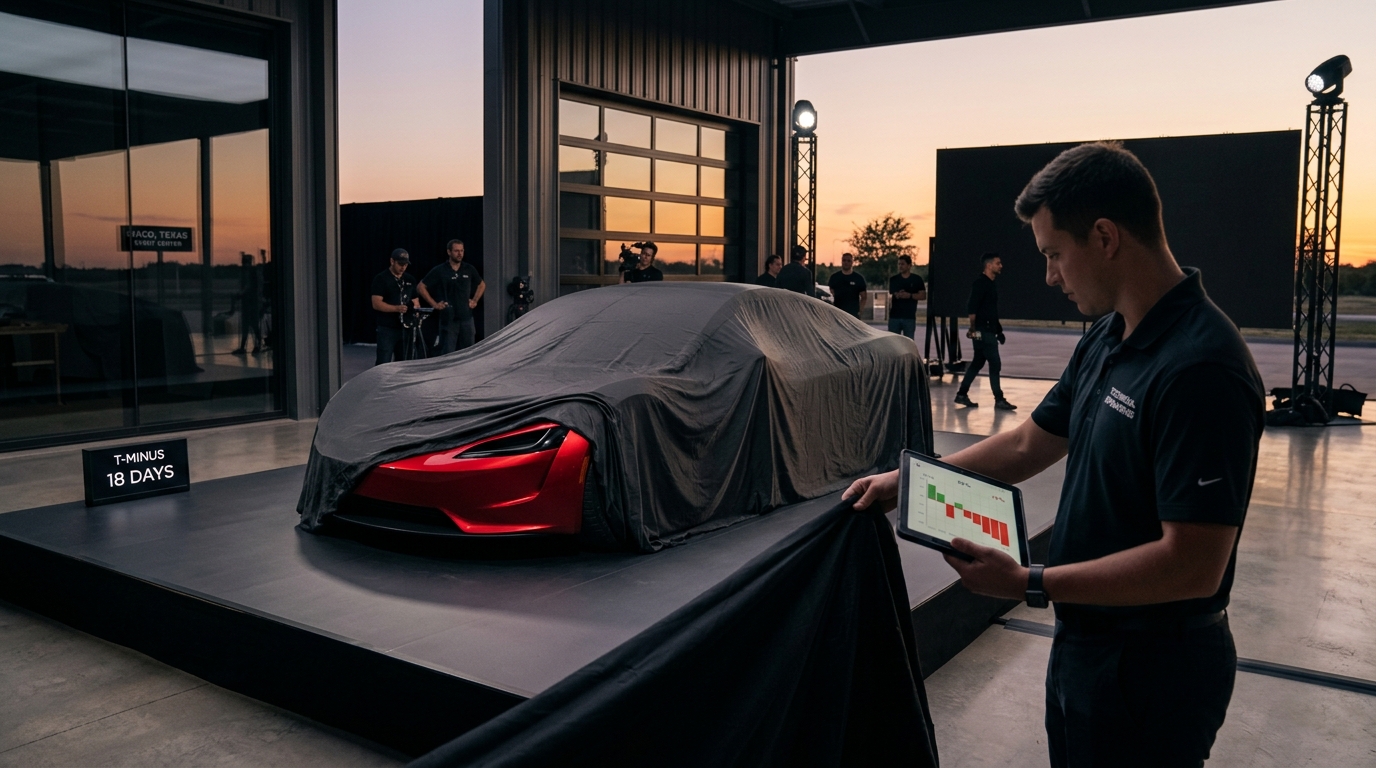
October 1 is on the calendar. Tesla posted a two-word message on X, “Go for launch,” tying that date to the reveal of its next-generation Roadster. The event is scheduled for 5:30 p.m. Pacific time in Waco, Texas. Eighteen days from today, Elon Musk will stand in front of an audience and either deliver the most credible product moment of his decade or add another chapter to one of the longest delays in automotive history.
The trade is not about whether the Roadster is real. It is about how the options market is pricing the event right now, and the answer is: not nearly enough.
The Story Behind the Trade
Tesla’s second-generation sports car was first announced in November 2017 and has been pushed back multiple times. At the November 6, 2025 annual shareholder meeting, Musk set the demo for April 1, adding that the date gave him “some deniability” because he could say he was just kidding. April passed. Summer passed. Target dates bounced from April into later 2026 windows before finally landing on October.
What separates October 1 from every prior date is the physical evidence behind it. Unlike prior teases, Tesla has circulated invitations to reservation holders that point to Waco, Texas. The Information has reported the car could come in two versions, including a limited model with SpaceX-derived cold-gas thrusters that could let it briefly lift off the ground. That is a specific, testable claim, and it will either land on October 1 or it will not.
The broader TSLA context matters too. The Cybercab launch on September 3 sent shares surging 5.42% to $376.37. That momentum is still fresh. Morgan Stanley’s Andrew Percoco reaffirmed an Equalweight rating with a $400 price target and lifted his bull-case scenario to $840, citing major upside from autonomous trucking. The gap between $400 and $840 tells you exactly how bifurcated sentiment is: the base case is modest, but the market knows the bull case exists and will move toward it on any meaningful positive catalyst.
Technical and Fundamental Alignment
Technically, TSLA is consolidating near the $365 area, where it has acted as a bull-bear dividing line in recent trading. The stock has been range-bound precisely because the next catalyst has not arrived. October 1 is that catalyst.
Dropping the Roadster unveil on October 1 puts it one day after the close of Q3 2026, meaning the reveal will be the first major Tesla event of Q4, and it lands right as the market starts focusing on Q3 delivery figures. Two potential catalysts stacked in 48 hours is not a coincidence.
Options Perspective
Here is where the opportunity sharpens. TSLA options imply roughly 40% annualized volatility around the 30-day at-the-money tenor in the days leading into September 11, which screens as low versus much of TSLA’s own one-year volatility history. Realized volatility has also recently run above implied, meaning options have been pricing less movement than the stock has actually delivered. In plain terms: premium is still relatively cheap for a stock that just moved more than 5% on the Cybercab launch.
The strategy that fits is a call debit spread expiring shortly after October 1, structured so that implied-volatility expansion into the event helps the long leg, and any post-event volatility crush is limited by the short leg. A rough example: buy the October 10 $380 call and sell the October 10 $410 call. The spread caps your risk to the debit paid, with maximum gain if TSLA closes above $410 at expiration. The thesis does not require a moonshot; it requires the reveal to arrive with genuine hardware and a credible timeline.
The principal risk is familiar: even after a big reveal, the Roadster may still be far from production. A reveal that impresses on design but disappoints on production specifics could cause shares to fade, just as the Cybercab risked a sell-off when the deployment count was in question.
Risk Management
Size this position so that losing the full debit paid is a rounding error in your portfolio. The defined-risk structure of a call spread makes that simple: you know your maximum loss before the trade is placed. If TSLA closes below your long strike at expiration, the spread expires worthless and you move on. Do not chase if IV spikes sharply in the week before the event and compresses the spread’s risk-to-reward. The entry matters as much as the idea.
The Beast Verdict
October 1 is a hard date with more evidence behind it than the typical Tesla tease: a stated date, a specific city, and invitations circulating among reservation holders. The options market has not yet priced that specificity in as aggressively as you would expect for a catalyst-driven tape. That is the edge. The Roadster reveal either delivers a credible production-intent car and sends TSLA toward its next resistance level, or it disappoints and the spread expires worthless. Either way, the risk is defined and the clock is running.