
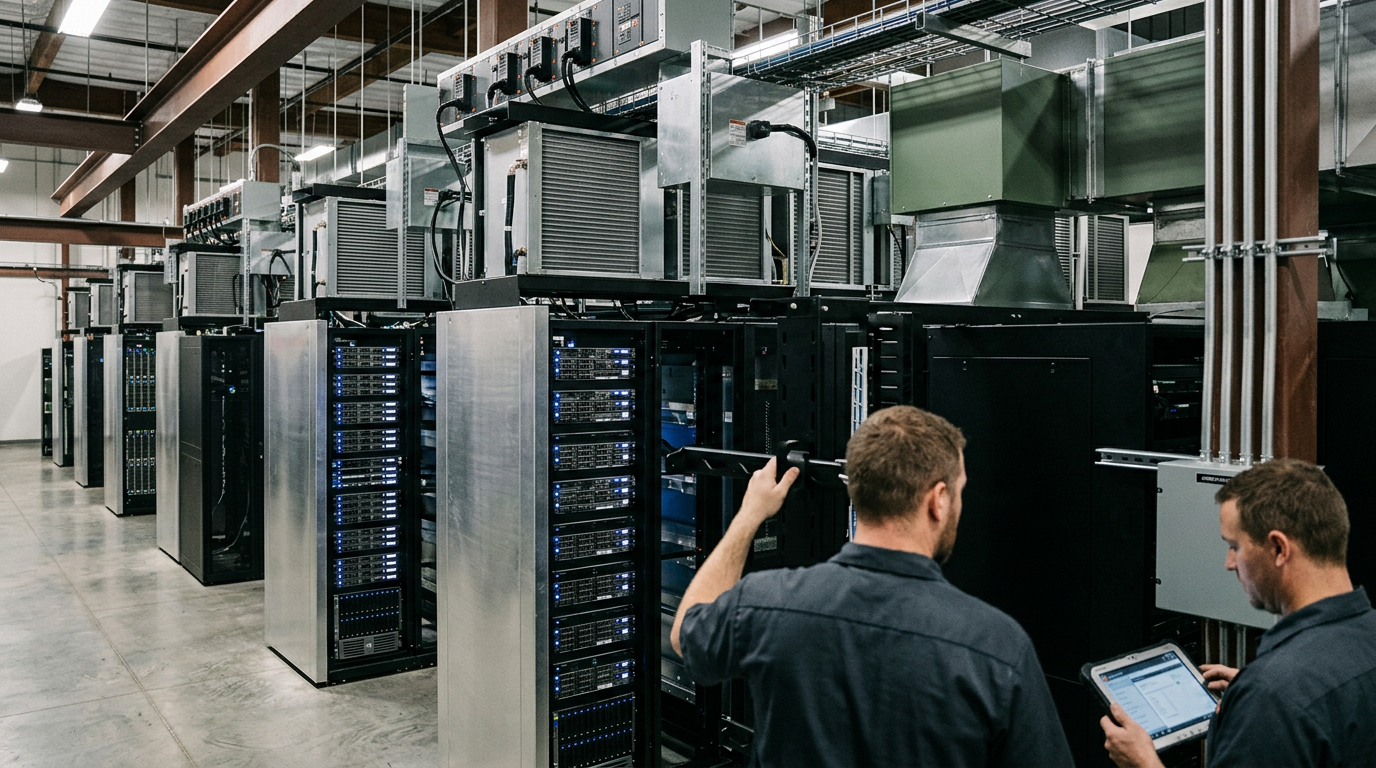
Most people think of the AI trade as chips. Nvidia, TSMC, memory. That’s the obvious layer. The less obvious layer — the one that has quietly produced an 84% year-to-date return — is the physical infrastructure underneath the chips. Power. Cooling. Racks. The stuff that has to exist before a single GPU can run at full load.
That’s Vertiv’s business. And on July 29, the company is widely expected to report Q2 2026 earnings.
Vertiv Holdings has become the pure-play name in AI data center cooling and power. The stock trades near $339 after Q1 2026 results sent shares higher. But here’s what’s interesting. Options flow in early July turned notably bearish. Vertiv Holdings put volume was heavy and directionally bearish on July 7. That’s a real data point worth tracking for a stock that has run this hard this fast.
The Q1 numbers were not subtle
Vertiv reported first quarter net sales of $2,650 million, an increase of 30% compared to first quarter 2025, driven by 23% organic sales growth, with the Americas region leading, expanding 44% on strong data center demand.
First quarter adjusted operating profit of $551 million increased 64% from Q1 2025. Adjusted operating margin was 20.8%, up 430 basis points, driven by operational leverage on higher volume and positive price-cost.
The backlog number is what traders keep coming back to. Vertiv ended 2025 with a $15.0 billion order backlog, up about 109% year-over-year, with a fourth-quarter book-to-bill near 2.9 times. That’s almost three orders booked for every one shipped. It’s not theoretical demand — it’s locked revenue with lead times. The project backlog more than doubled to over $15 billion, covering roughly 12 to 18 months of forward revenue.
Management raised 2026 guidance to $13.5 to $14.0 billion in net sales, implying 29% to 31% organic growth and 44% to 51% adjusted diluted EPS growth for the full year. That’s not a company guiding conservatively.
The acquisition trail tells the story
What Vertiv has been doing quietly in 2026 is building out every link in the thermal chain. In March, Vertiv announced an agreement to acquire ThermoKey S.p.A., a leading provider of heat rejection and heat-exchange technologies, as part of Vertiv’s continued investment in advanced cooling solutions to support high-density AI data centers. That deal closed in June.
Then in April: Vertiv acquired Strategic Thermal Labs LLC, a specialist in advanced liquid-cooling technologies. The acquisition extends Vertiv’s thermal-chain strategy by strengthening engineering capability at the interface between server-side liquid cooling and supporting infrastructure — an increasingly critical factor in high-density, liquid-cooled environments supporting AI and high-performance computing workloads.
And in July: Vertiv announced the opening of its manufacturing facility in Johor, Malaysia, expanding the company’s manufacturing footprint to support growing demand for AI and high-density computing infrastructure.
Three moves in four months. All pointing the same direction.
The valuation question heading into July 29
Here’s where it gets complicated. At the June 18 close near $333, VRT carried roughly a $128 billion market cap and traded around 48 times forward earnings, near a five-year valuation high. Its FY2026 guidance implies about 34% sales growth, so the multiple assumes the AI buildout keeps compounding.
That’s the tension. The business fundamentals are as clean as they come. But the multiple prices in a very specific future where hyperscaler capex never pauses, liquid cooling adoption stays on the current trajectory, and EMEA accelerates. EMEA needs to stop bleeding by Q4, AI orders need to keep running hot into 2027 on 800-volt and liquid cooling adoption, and the multiple has to hold. A hyperscaler capex pause would derail it.
Traditional air systems are proving insufficient for modern AI clusters. Liquid cooling is becoming the new standard for its efficiency and effectiveness. That tailwind is real. A report by Persistence Market Research recently predicted the global data center liquid cooling market would grow to $29.2 billion by 2033 from $5.7 billion in 2026. But at 48x forward earnings, VRT needs to be right about all of it, not just most of it.
Options market structure around July 29
The put flow that showed up in early July is worth taking seriously. It could be institutional hedging on a long position. It could be outright bearish positioning into the earnings event. Either way, it shows the options market is not uniformly bullish into this report despite the stock’s year-to-date run.
Q2 2026 earnings are widely expected on July 29. Consensus EPS sits near $1.43. Watch the order book number and any updated full-year guidance.
For traders expecting the bull case — backlog conversion beats, guidance raised again, EMEA shows improvement — a defined-risk bull call spread in the August expiry gives upside participation while capping the loss if the report disappoints. Something like a long call at or near the money paired with a sold call 15-20% above current price captures the expected move range without open-ended risk.
For traders who want to fade the run and position for a sell-the-news reaction — which is historically common when a stock has already gained 84% year-to-date entering earnings — a bear put spread in the August expiry captures downside while limiting premium at risk. The bear case doesn’t require the business to be bad. It just requires the quarter to meet, not exceed, the elevated bar the market has already priced in.
The neutral case: an iron condor using August expiry wings that contain the expected move range captures IV premium if the stock’s reaction stays inside a defined range. High IV heading into earnings makes premium selling more attractive, but the trade carries risk if guidance moves the stock sharply in either direction.
What to watch on July 29
The order intake number for Q2 matters more than the revenue beat. If book-to-bill stays elevated and EMEA order momentum turns, the bull case gets another leg. If hyperscaler order cadence shows any deceleration — even a modest one — the stock’s multiple will be the first casualty.
CEO Giordano Albertazzi cited very robust data center demand growth, while Chairman Dave Cote said the AI infrastructure buildout remains in its early stage. If they maintain that framing with Q2 data to back it up, the stock likely holds or extends. If their tone shifts even slightly, the multiple will compress faster than the backlog converts.
- VRT reports Q2 2026 on July 29
- Consensus Q2 EPS: approximately $1.43
- Key watch items: Q2 order book, book-to-bill ratio, EMEA recovery, full-year guidance revision
- Bull case: beat on orders, guidance raised, EMEA improvement — defined-risk bull call spread in August expiry
- Bear case: in-line results, no guidance raise, multiple compression — bear put spread in August expiry
- Neutral case: iron condor using August expiry to capture IV premium if stock stays range-bound post-earnings
- Note: put flow turned heavy and directionally bearish in early July — monitor heading into earnings date
- All options structures involve defined but real risk of losing the full premium paid; this is analysis, not a trade recommendation