
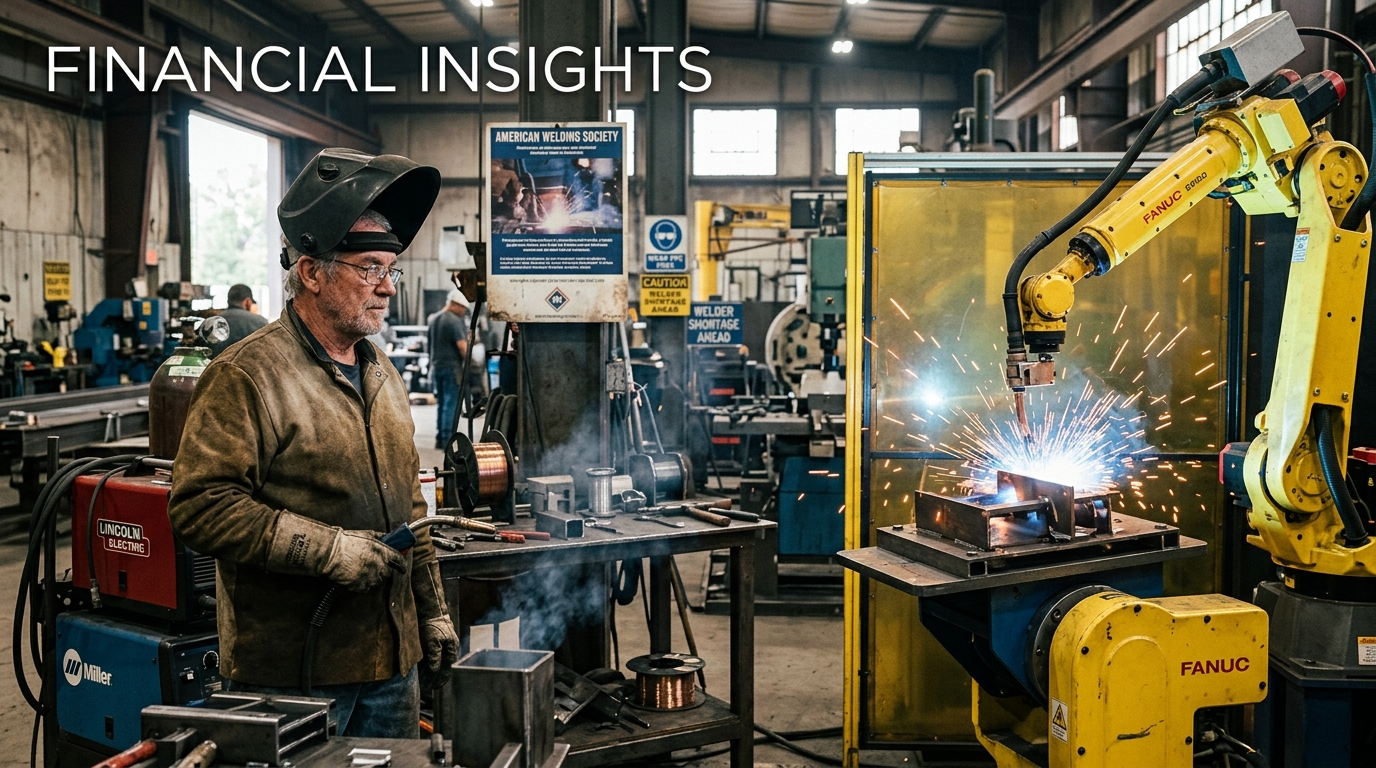
Start with a labor problem nobody is romanticizing.
There are roughly 771,000 welding professionals in the United States. The American Welding Society projects that 330,000 new welding professionals will be needed by 2028, with an average of 82,500 welding jobs to fill annually. The shortage is being driven by an aging workforce, fewer young workers entering the trades, and rising demand across construction, automotive, energy, and infrastructure.
Here is the part that doesn’t show up in the press release: the average age of a welder in the U.S. is 55, meaning a massive portion of the skilled labor base will retire in the next decade. And the American Welding Society notes that only about one new welder enters the workforce for every two retiring.
That is a structural collapse, not a cyclical dip.
Now layer on something else. JR Automation identifies reshoring as a particularly potent demand driver in 2026, with rising tariffs, shipping costs, and overseas wages pushing production back to the United States and increasing the urgency for efficient, localized operations. Hundreds of billions in announced commitments are flowing into domestic facilities. GlobalFoundries has committed $16 billion to reshore chip manufacturing. Stellantis announced $13 billion in U.S. production investment. Johnson and Johnson is spending $55 billion to build domestic facilities.
Every one of those facilities needs steel joined to steel. Every one of those production lines needs welding. And there are not enough people left to do it by hand.
This is where the second-order effect kicks in.
The Force Nobody Is Tracking
The shift toward rebuilding domestic manufacturing in the United States is accelerating, driven by persistent supply chain fragility, geopolitical uncertainty, and tariffs. To remain competitive with lower-cost economies in Asia, manufacturers are increasingly turning to automation to boost output per worker.
That pressure has a specific mechanical outlet. The global welding consumables market is seeing a significant shift in product mix, driven by the accelerating adoption of automated and robotic welding systems, which favor continuous wire products over traditional stick electrodes.
Think about what that means for a moment. Every robot welder deployed on a U.S. factory floor runs continuously — 24 hours if the line demands it. A human welder cannot. A robot draws wire constantly, burns through shielding gas, needs replacement contact tips and liners. The consumable volume per unit of output goes up, not down, when you automate welding. No structural weld is possible without consumables, making this market non-discretionary within its served industries.
The robotic welding market itself confirms the direction. The global robotic welding systems market is projected to expand at a compound annual growth rate of 6 to 8 percent from 2026 to 2035, driven by sustained automation investment across electronics, automotive, and general industrial sectors. And the aftermarket piece — the consumables and replacement parts — contributes a stable recurring revenue base with margins that tend to run higher than the equipment itself.
Slight tangent, but it matters: the reshoring boom, despite headlines, is not happening as fast as politicians suggest. A reshoring boom driven by U.S. tariffs has not fully materialized based on macro data, with U.S. manufacturing construction spending having steadily declined since 2024, dragged down by a 44% slowdown in electronics factory and semiconductor fab spending since their peak in mid-2024. What that actually means is that the replacement wave of automation — driven by the welder shortage and not just tariff politics — has a longer and more durable runway than the political cycle would suggest. It is structural. Not seasonal.
The Company Three Layers Deep
The obvious play is the robot arm. FANUC. ABB. Yaskawa. Wall Street already owns those ideas.
The less obvious play is what every robot arm in every new U.S. factory consumes every single day it operates: wire, flux, electrodes, and the integrated intelligence to deliver them consistently at industrial speed.
That is Lincoln Electric.
Lincoln Electric is a manufacturer of welding, cutting, and brazing products, claiming leading market share globally. Alongside rivals ITW and ESAB, Lincoln Electric is one of the top three players offering a complete welding-solutions package, including equipment and consumables, which differentiates the firm from smaller competitors.
Here is what makes the story interesting right now. Lincoln Electric is not just a consumables company. It has been quietly building an automation platform for years — acquiring robotic welding integrators and positioning itself as the company that sells the robot cell, the software that programs it, AND the wire it burns through every shift. Lincoln Electric is actively pursuing a multi-faceted expansion strategy focused on strategic acquisitions and broadening its product and service offerings. The company completed three acquisitions in 2024, including Vanair, Inrotech, and RedViking, bolstering its automated welding solutions portfolio.
DA Davidson recently initiated coverage on Lincoln Electric with a Buy rating, citing its exposure to reshoring, Industry 4.0, and automation, alongside strong return on invested capital. The firm highlighted that automation solutions already account for more than one-fifth of Lincoln Electric’s sales, underscoring the company’s growing role in advanced, productivity-enhancing welding technologies.
The Q1 2026 numbers backed that thesis. First quarter 2026 sales increased 11.7% to $1.12 billion, reflecting a 7.8% increase in organic sales, with operating income of $186.2 million, or 16.6% of sales. And management has not stopped there. The company lifted its 2026 sales outlook and introduced its new long-term RISE strategy, which focuses on technology, automation, and strategic acquisitions to drive growth.
What’s interesting is the backlog element. Management has guided for mid-single-digit sales growth in 2026, expecting the automation backlog to ramp in the second half of the year and beyond. The second half ramp is the part the market may not be fully pricing yet.
What Wall Street Is Missing
To own Lincoln Electric, you generally have to believe that welding automation, reshoring, and Industry 4.0 can support a durable, higher-value business mix. Most of the analyst community has framed this as a cyclical recovery story. They are underweighting the structural driver: by most estimates, the U.S. welder labor market will reach a deficit of 375,000 workers by 2026. That gap does not close regardless of the economic cycle. It only widens as the reshoring investment compounds and the retiring workforce does not come back.
The valuation debate is real. The stock currently trades at a forward price-to-earnings multiple of around 24.7. That is not cheap in a vacuum. But the question is whether the market is pricing a cyclical industrial company or a recurring-revenue automation platform with a structural labor tailwind underneath it. Those two things have very different multiples.
Lincoln Electric reports earnings on July 29, 2026, before the market open. The consensus EPS estimate for that quarter is $2.85, with revenue expected around $1.19 billion. The automation backlog ramp management flagged for the second half starts showing up in that report.
The part people skip: Lincoln Electric’s dividend has increased by an average of 10% per year over the past 10 years, with a stable payout and no material reductions, indicating a long track record of dividend growth. A compounder with a structural labor shortage underneath it and a 10-year dividend growth streak is not what the market is calling it right now.
The welder shortage is not going away. The factories being built still need to join metal to metal. And the company selling the robot, the wire, and the software to do it — quietly, without CNBC covering it — reports in 18 days.