
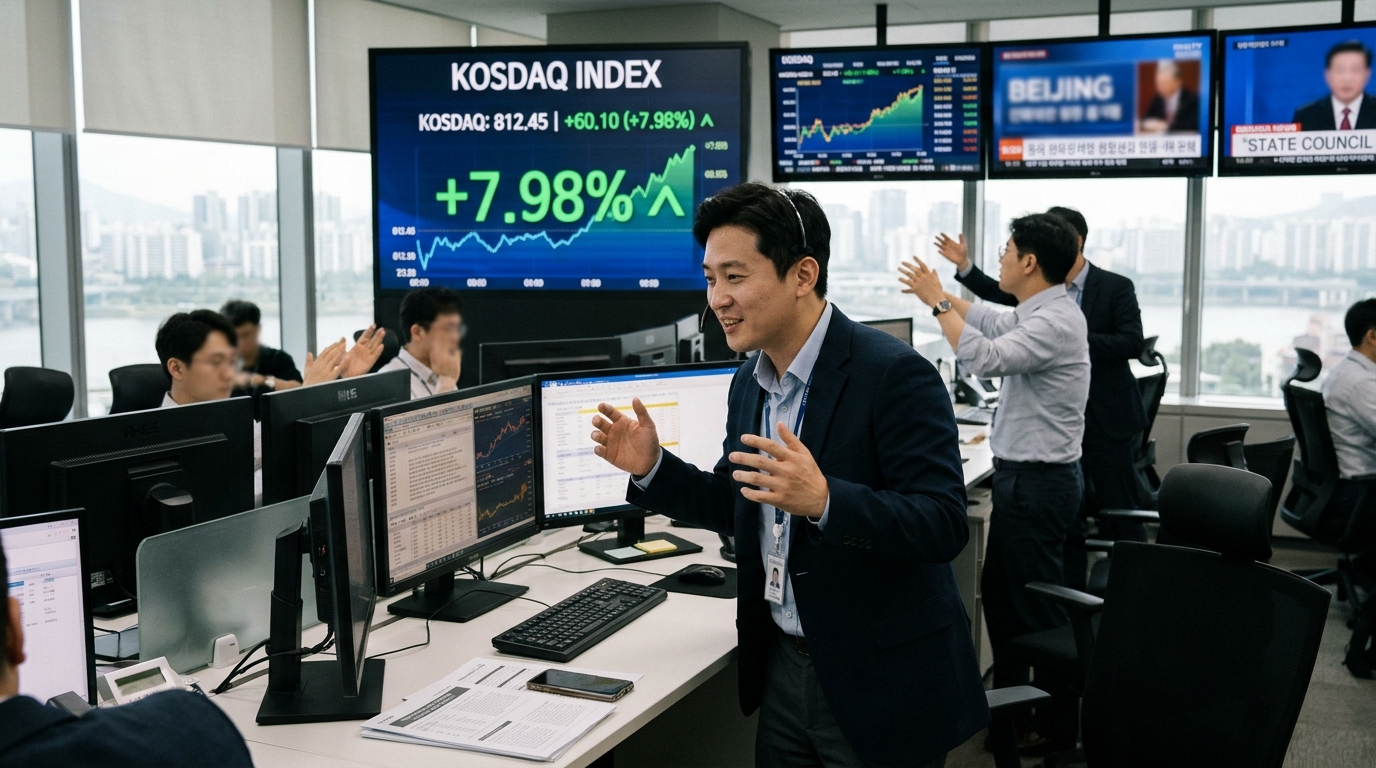
What Beijing actually released this morning was a list of intentions. What Seoul priced in looked more like a done deal.
China’s State Council pledged at its November 27 executive meeting to implement existing policies, plan new incremental measures, strengthen the state-backed “national team”, push listed companies to raise dividends and buybacks, and guard against imported risks. The meeting disclosed neither the scale nor the timing of any new measures. That is the full extent of what was concrete.
China’s own markets reacted with proportional enthusiasm for a vague signal. The CSI 300 climbed 4.17% to 4,063.06, while the ChiNext Index surged 11.61% to 2,443.96 and the STAR 50 added 15.07%. Those are large moves, but they came on top of a market that, as of Thursday, was sitting at its lowest since June 2025 and remains down 13% year-to-date, on track for its worst annual performance since 2022. Oversold bounces after prolonged declines are routine. The ChiNext move was dramatic; it was also the index’s largest single-day gain since September 30, 2024.
South Korea’s reaction is a different category of event. The Kospi closed up 4.34% at 4,915.68, while the Kosdaq jumped 8.13% to 708.99. The Kosdaq’s gain was its biggest since July 31, when it rose 11.63%. The proximate cause was not Beijing’s statement. It was a domestic one: South Korean financial authorities are expected to hold an emergency market stabilization meeting on November 30 to discuss expanding and activating the Securities Investment Fund, which the market anticipates will be increased from its current 10 trillion won level.
Samsung Electronics rose 4.55% to 179,100 won, and SK hynix climbed 5.41% to 1.11 million won. Both moves were driven by foreign and institutional flows, not by any new information about their underlying businesses. On the Kosdaq alone, foreign investors and institutional investors made net purchases of 307.4 billion won and 586.6 billion won, respectively. That is a positioning trade, not a fundamental reappraisal.
The gap between the two events deserves to sit at the center of any reading of today. Beijing produced a statement. Seoul produced an 8% day on a junior exchange, triggering the 41st sidecar on the Kosdaq this year. The connection between the two is mood, not mechanics. China is not a direct buyer of Samsung chips through any of the five pledges disclosed today. Central Huijin does not purchase Kosdaq small-caps. What Beijing’s statement did was shift regional risk appetite at the margin, arriving on the same day Seoul’s own stabilization fund story was accelerating.
What the Market May Be Missing
The State Council meeting, chaired by Premier Li Qiang, stressed the need to “mull and introduce new measures” for the capital market and set out no figures or timetable. That phrasing has appeared in previous rounds of support rhetoric that preceded months of further declines. The readout carried by state media said authorities should further strengthen sovereign investor Central Huijin and ensure ample liquidity, which is language the national team has used without deployment before.
Seoul’s stabilization fund meeting on November 30 is the more testable near-term event. If the fund is expanded and deployed, the rally has a mechanical bid behind it. If the meeting produces its own statement of intent without a commitment size, today’s 8% Kosdaq session will look like what it was: a sentiment reading, not a fundamental one. EWY and FXI both captured the euphoria today. The question is whether the follow-through comes from policy action or fades when the specifics prove as thin as Beijing’s.
Risks and Counterpoints
The bull case is straightforward: coordinated state intervention from two governments simultaneously is a credible floor, and the Kosdaq had fallen far enough that any catalyst could unlock a sharp short-covering rally. The bear case is that foreign selling, memory-chip oversupply fears, and high interest rates threaten a lasting recovery for Korean semiconductor names. Neither Samsung nor SK hynix has seen a change in their order books today. The Kospi is still down roughly 46% from its June peak above 9,000. One session does not close that gap.
What to Watch Next
Three things will determine whether today’s move holds: the size and activation terms of Seoul’s fund when authorities meet November 30; whether Beijing follows its statement with a disclosed capital commitment in the coming weeks; and whether foreign investors, who drove today’s buying, sustain net inflows or revert to the selling pattern that dominated November’s earlier sessions.