
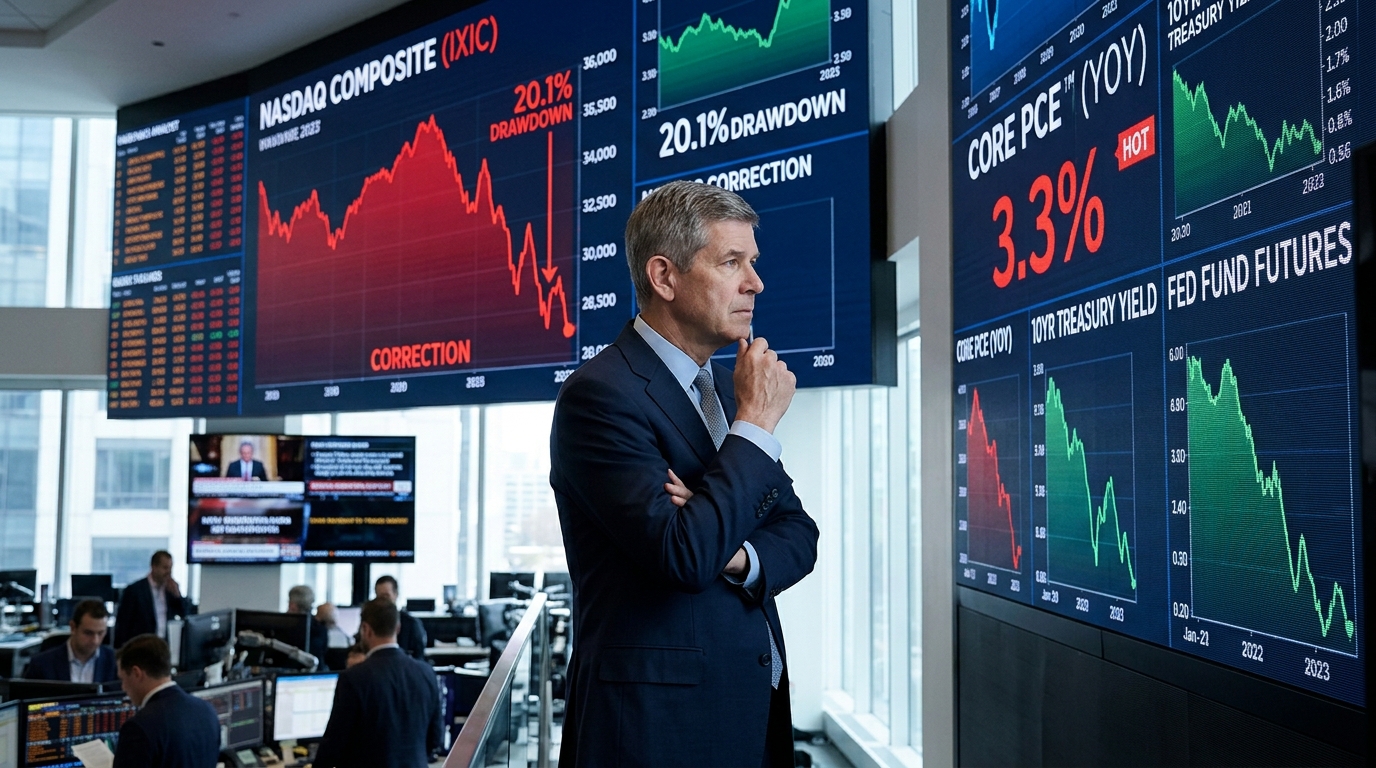
The bond market is sending a message Kevin Warsh has probably already heard: the equity selloff may be doing his job for him. Core PCE rose 3.3% year over year in October, above the 3.2% forecast and up from 3.1% in September. That 3.3% reading is the highest since November 2023. By any traditional policy framework, it seals a December hike. And yet the rates market responded by buying Treasuries. Yields fell across the curve, with the 10-year dropping as much as 10 basis points to a roughly three-month low of 4.80%. The dollar index fell about 0.22% to roughly 103.62 after the data release.
That inversion of the usual reflex deserves attention. Hot inflation data normally pressures yields higher as traders price in more Fed tightening. Wednesday’s 10-year move was the eighth straight daily decline in yields, even though the inflation data argued for higher rates. The bond market is not ignoring the PCE print. It is telling you something about how much tightening the equity market has already delivered.
The Nasdaq 100 entered a technical bear market on November 25, declining 20% from its early-October peak. More than $8.5 trillion in value has been erased during the rout. The drawdown remains concentrated in AI hardware and other rate-sensitive corners of the market, while equal-weighted and defensive equities held up markedly better. That matters for the Fed’s calculus: a correction this concentrated in capital-intensive, rate-sensitive AI infrastructure tightens financial conditions in ways a headline index level alone does not capture.
The Wall Street Journal Fed reporter Nick Timiraos framed the choice directly overnight. Timiraos wrote that Warsh could face a choice between raising interest rates to fight inflation or heeding market signals suggesting a broader slump could do some of that work for him. Timiraos also noted that if the technology-stock rout deepens, it could increase pressure to weigh those market signals more heavily. Neither path is clean. Hike into a bear market and Warsh risks accelerating a growth shock that could force him to reverse course in 2027. Hold, and he risks looking soft on inflation that is now at a three-year high on the core measure.
The Beige Book released Wednesday added texture. Economic activity grew in eight of the Fed’s 12 districts, but businesses continued to face rising costs and customers who resisted higher prices. Input costs were rising faster than selling prices, putting pressure on corporate profit margins. That is not a recession signal, but it is also not a picture of an economy running so hot that a pause would be reckless.
Governor Waller said a half-point increase at the December 8-9 meeting is probably necessary, though he acknowledged a quarter-point hike paired with a January signal would be an alternative, one that runs contrary to how Warsh has preferred to communicate. Warsh has been against that kind of forward guidance on the grounds that it ties policymakers’ hands.
For traders, the actionable question is positioning around the December 8-9 decision. Futures pricing implies very high odds of a quarter-point December hike, and a falling 2-year yield alongside steady December odds means traders still expect a move but are pricing in fewer hikes after it. That is the spread that matters: not whether Warsh hikes in December, but whether a 20% Nasdaq drawdown persuades him the 2027 path is now shallower than the dot plot implies. If Warsh signals any such shift in the December statement, duration and rate-sensitive growth names are the first beneficiaries. If he hikes and says nothing has changed, the equity selloff has further to run. Watch TLT for the bond signal and QQQ’s ability to hold above its November 25 intraday low as the clearest real-time read on which outcome markets believe is coming.