
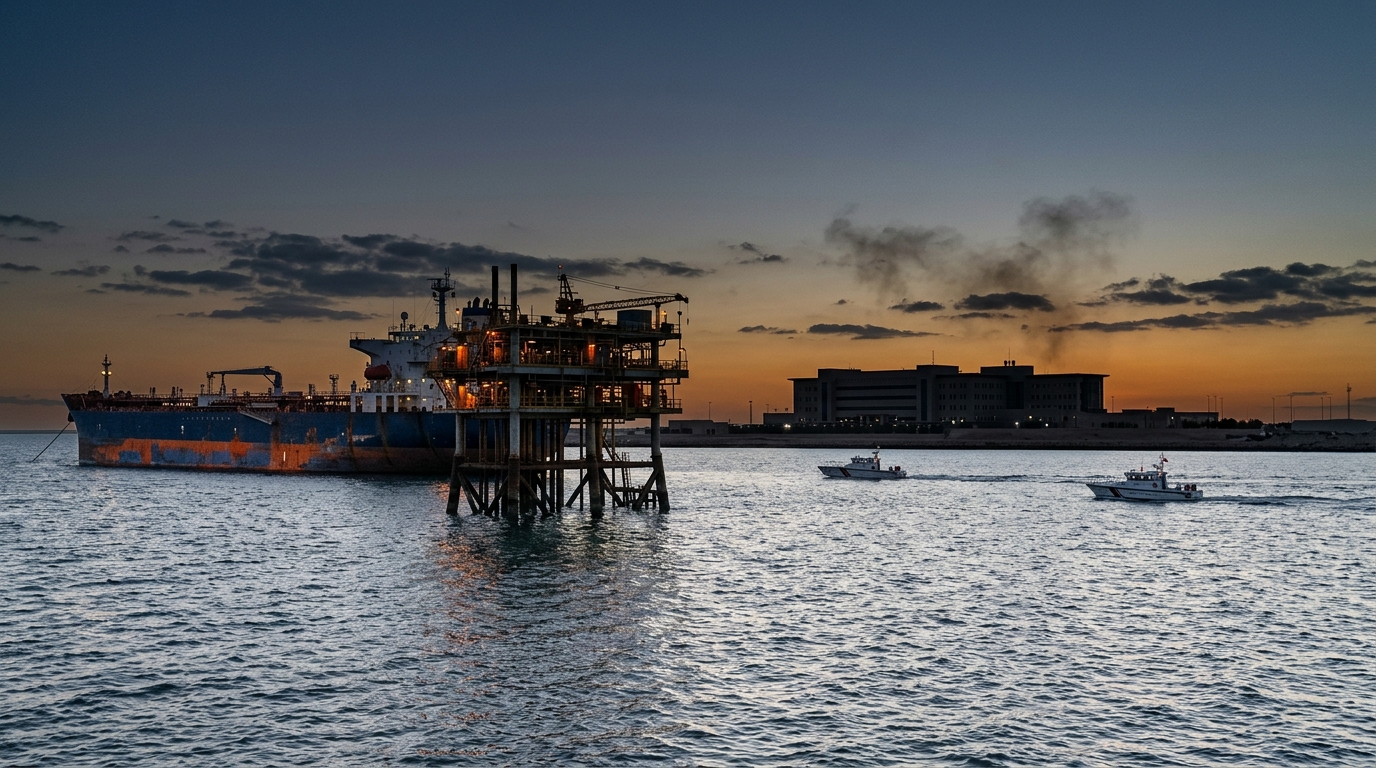
Sunday before dawn, sirens rang out across Bahrain. The Islamic Revolutionary Guard Corps said it launched six drones toward a U.S. radar facility in Bahrain, describing the attack as a response to the “blatant aggression of the US military.” The IRGC reported a “successful impact,” while Bahrain said its air defenses intercepted a number of Iranian projectiles before they reached their targets. After a lull in attacks, Bahrain, which hosts the U.S. Navy’s 5th Fleet, has now been targeted again in recent days.
The oil market’s verdict: largely indifferent. Brent was trading around the mid-$95 range early Monday, but it did not sustain a meaningful risk premium. Brent futures were down 47 cents, or 0.49%, to $95.37 per barrel at 01:45 GMT, while WTI fell 23 cents, or 0.26%, to $88.33. A direct Iranian strike claim involving a Gulf state hosting U.S. forces, and the net move was still modest.
The reason crude won’t hold a bid sits squarely with supply. The world oil market will return to a surplus in the fourth quarter of this year, the International Energy Agency said Friday, as Middle East exports recover faster than global oil demand despite continued attacks on shipping. The IEA has also said the fourth-quarter balance flips back into surplus versus its prior view, as flows rebound and demand softens.
Shipments from the Gulf have been recovering toward pre-war levels, which removes the core justification for a sustained risk premium. Physical market weakness is confirming the picture: recent EIA data show U.S. commercial crude stocks building again, with commercial inventories at 414.4 million barrels for the week ending November 6. When barrels are accumulating onshore, an intercepted drone salvo doesn’t change the math enough to matter.
There is also a demand problem layered underneath. Traders are watching for weaker consumption signals tied to China and the broader macro backdrop, even as product markets shift into winter patterns. Sparta Commodities analyst Jun Goh has flagged diesel supply as an emerging variable as winter heating demand increases, while weakness in the spot crude market continues to put downward pressure on Brent and WTI futures.
So what would actually force a durable break higher? The answer is a Hormuz disruption that the physical market can’t route around. A significant escalation and deterioration in shipping around the Strait of Hormuz and alternative routes could drive Brent above $100 per barrel, with targets above $100 coming into view. Six drones over Bahrain don’t get there. What gets there is a renewed, sustained closure of the strait that flips the supply balance back into deficit.
Until that threshold is crossed, the structure of this market rewards selling geopolitical pops rather than chasing them. Traders carrying energy exposure should treat the $96 to $97 zone as a ceiling unless Hormuz traffic data deteriorates materially. The bear case sits at $91 to $94, where the surplus math and softening demand could combine to test support. The bull trigger is specific: physical flows through the strait declining again, not headlines from a Bahraini base.