
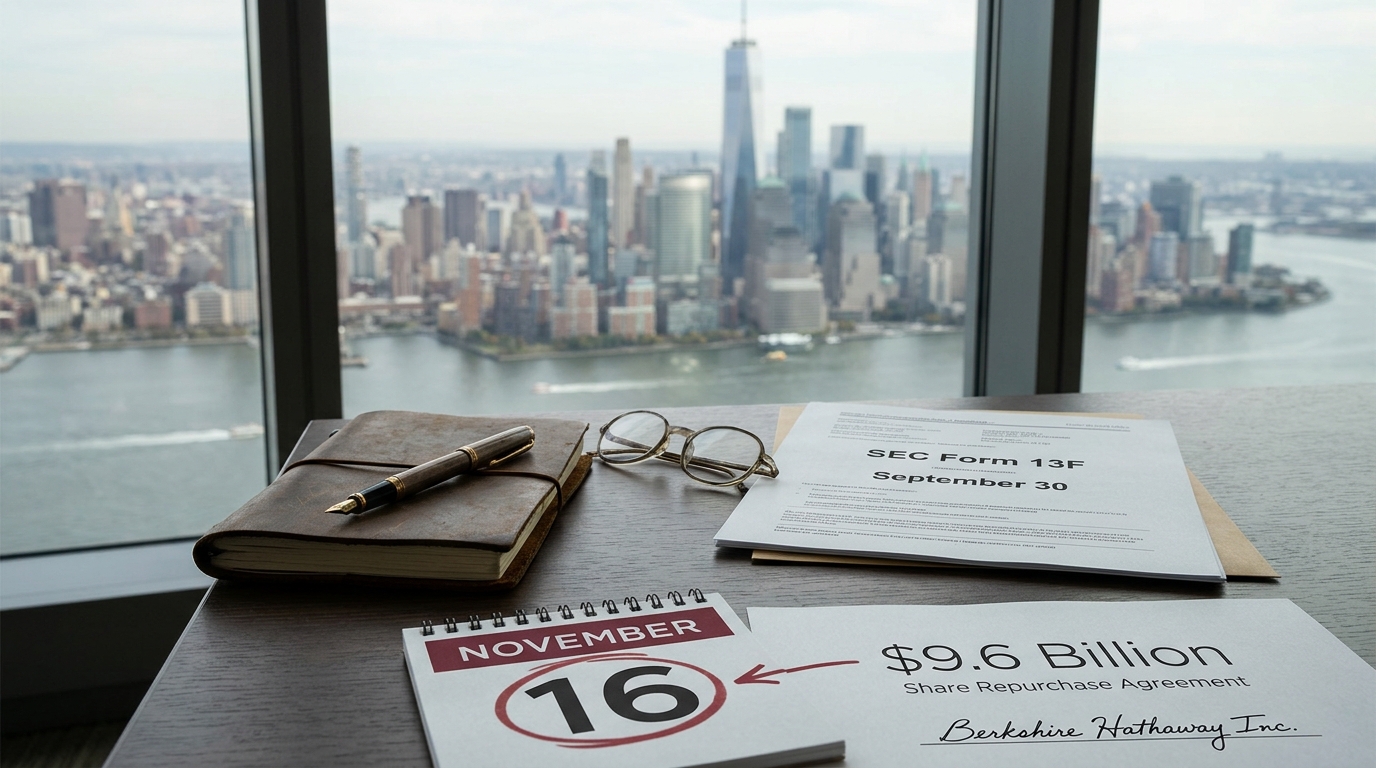
Monday, November 16, is the SEC deadline for Form 13F filings covering positions held as of September 30. Every major institutional manager must report by then, and financial media will spend the week parsing the results. Before you act on any of it, understand what these documents actually are: a 45-day-old photograph of a portfolio that may look nothing like it does today.
The timing makes this quarter’s filings unusually revealing. Nvidia set a record high on October 6, and the stock is down about 30% since then. The technology sector also sold off in October as investors worried about borrowing costs and the durability of AI infrastructure spending. Then, late this week, Nvidia CEO Jensen Huang resigned after reports tied his extramarital affair to what the company described as a potential foreign intelligence effort. In all, these headwinds sent shares down by about 30% from the all-time high they reached in October.
So every 13F landing Monday will show what large funds held at the top. Any manager who was heavily long Nvidia, or the broader AI complex, on September 30 was sitting on positions they may have since cut, held, or added to. You will not know which. That is not a small caveat.
What Berkshire’s Moves Actually Signal
Berkshire Hathaway will file its next 13F on November 16, 2026, and that filing will show holdings as of September 30, 2026. The conglomerate’s portfolio finished the quarter valued at $335.5 billion, with the five largest holdings, Alphabet, American Express, Apple, Bank of America, and Coca-Cola, accounting for 65% of the entire portfolio.
The equity book matters less here than the capital allocation story running alongside it. Berkshire repurchased $9.6 billion worth of its own shares in the third quarter, bringing the nine-month total for 2026 to about $14.4 billion. Berkshire buys back stock when CEO Greg Abel, after consultation with the chairman, judges the price to be below the company’s intrinsic value, conservatively determined, and its filings show an average repurchase price in the third quarter of roughly $500 per Class B share.
That is the signal worth internalizing. While other large funds were fully committed to the AI trade at the September quarter-end, Berkshire was directing its single largest quarterly capital outlay in years toward its own shares. The sharp increase came as Berkshire’s operating earnings, those from wholly-owned businesses, fell year over year, as profits from its insurance operations pulled back. Even so, over the first nine months, operating earnings grew about 8.0% to $37.0 billion. Management judged its own stock the better opportunity. That is a form of portfolio positioning, and it does not appear on any 13F.
How to Read Monday’s Filings Without Getting Burned
Three principles apply to every disclosure that lands this week. First, the positions are stale by definition. Because 13F positions come out about 45 days after the quarter ends, they may have changed since. Any fund that held Nvidia heavily on September 30 had a front-row seat to a roughly 30% decline and Jensen Huang’s resignation before this filing ever became public. Their current view may be entirely different.
Second, the filings are incomplete. The report only counts certain U.S.-listed long positions, leaving out wholly owned businesses, private stakes, and cash. Short positions, many derivatives, and foreign-listed holdings are generally invisible. What you see is a floor, not a ceiling.
Third, context beats copying. The useful question is not “what did this fund own?” It is “why did they own it, and does that reasoning still hold?” For Berkshire, Alphabet is one of the five largest holdings, and Monday’s filing will show whether Berkshire kept adding shares in the September quarter, held them flat, or sold some. That answer, combined with the buyback acceleration, tells a coherent story about where patient capital was going before the drawdown hit.
The Wealth Builder Takeaway
Monday’s filings are a research starting point, not a trade list. Use them to understand the conviction levels and portfolio construction of managers you respect. Then do your own work on whether the thesis that drove those positions on September 30 still holds in mid-November. The investors who built lasting wealth were never the ones who copied last quarter’s holdings. They were the ones who understood the reasoning well enough to know when to follow and when to look elsewhere.