
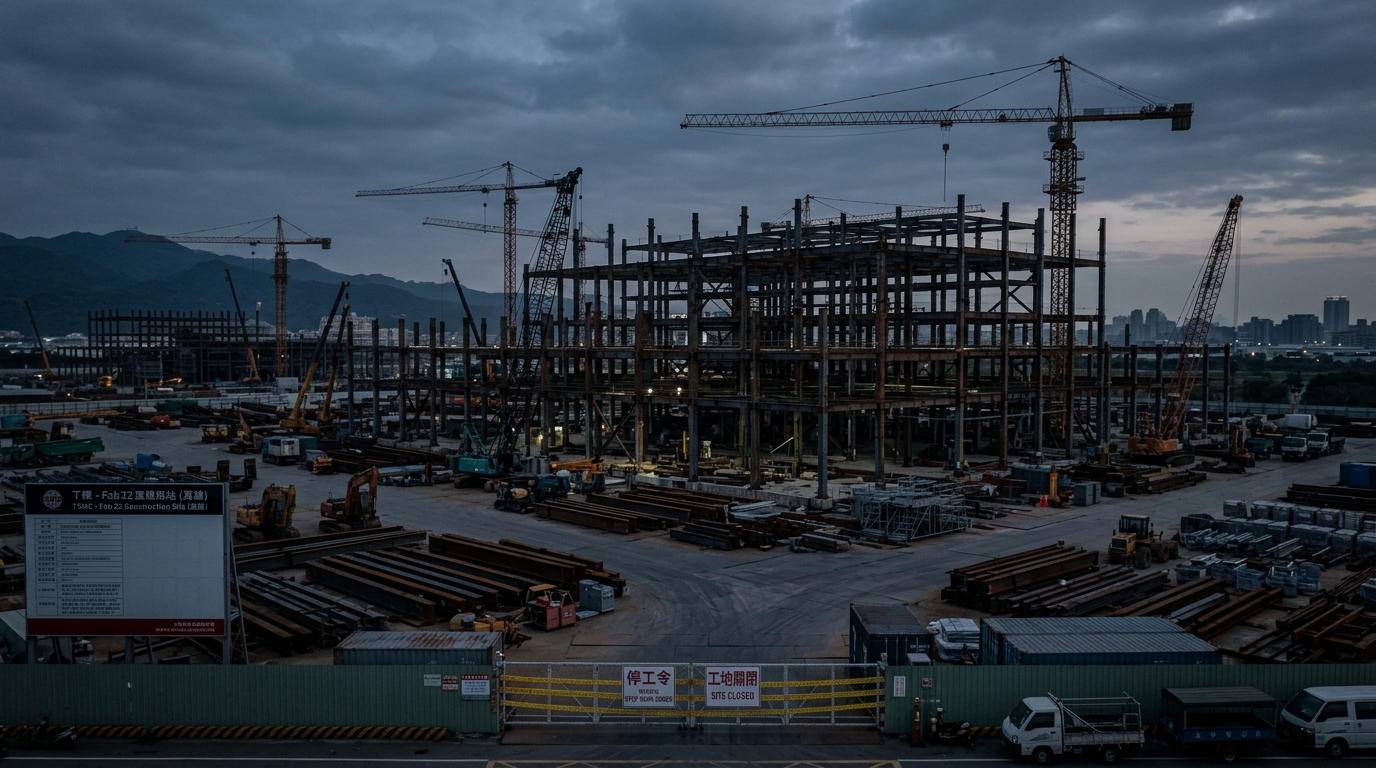
The question investors are asking this morning is whether the tragedy at TSMC’s Kaohsiung site is a contained accident or a signal about something structural. The answer, on the evidence available, looks closer to the latter.
Four workers died after falling from a steel structure during a construction accident at TSMC’s Fab 22 site in Kaohsiung on Tuesday, October 20, 2026, with preliminary reporting pointing to a suspected bolt failure. The fourth worker died from injuries in hospital on Wednesday, October 21, 2026. Bolts on a connecting plate of the third-floor exterior steel structure were reported to have broken, causing workers and steel components to fall. All four were reported to have been wearing safety harnesses, but the structural collapse prevented the lines from functioning.
TSMC’s response was fast and sweeping. The company said steel-structure work at the Kaohsiung site and at its new fab construction sites across Taiwan had been voluntarily suspended pending investigation. That is not a single-site shutdown. It is a system-wide pause across the buildout pipeline.
Why Institutional Investors Are Paying Attention
The debate among portfolio managers is not about the accident itself. It is about what the suspension reveals: TSMC is simultaneously managing one of the most ambitious construction programs in semiconductor history, and it just discovered that a single point of failure can force broad stops in critical path work.
TSMC has said it is actively expanding its manufacturing network, with large numbers of facilities in Taiwan and multiple overseas sites under construction. Industry reporting has suggested as many as ten facilities could be under construction or preparing to begin operations across Taiwan’s major science parks in 2026. Many of those projects rely on similar steel-structure work. A broad pause, even if time-limited, creates a shared bottleneck.
At the 1.4nm Fab 25 project in Taichung, public reporting this year has pointed to accelerating construction and progress on early buildings. Any schedule buffer there may absorb part of a short interruption. Sites with less runway cannot say the same.
The Bull Case: Pause, Not Derailment
Bulls argue that TSMC has navigated geopolitical risk, equipment shortages, and pandemic-era supply chain chaos without missing a major capacity milestone. A safety-driven work stoppage, once inspections clear, typically resolves in days to weeks rather than quarters. At Fab 22 specifically, industry reporting has said P1 is in volume production and P2 has entered trial production, with additional phases under construction and all five plants expected to be fully operational by Q4 2027. The revenue-generating infrastructure is running. What is paused is expansion.
The Bear Case: Contractor Capacity Was Already the Binding Constraint
The more uncomfortable read is that skilled construction labor and qualified contractors were already scarce before Tuesday evening. TSMC’s most recent 2026 capital expenditure guidance was raised to $60 billion to $64 billion. Deploying that capital requires not just money but workers, steel crews, and contractors who know how to build a cleanroom. A fatal accident triggers not only a work suspension but also regulatory scrutiny, potential changes to hoisting procedures, and possible contractor reassignment.
The clients who depend on TSMC finishing on time are not abstract. Nvidia’s next-generation GPU production roadmap runs through TSMC’s advanced nodes. Apple sources the chips in every iPhone from the same fabs now sitting behind yellow tape. Any schedule slip that compounds across multiple sites becomes a problem for customers who have already built product launch windows around TSMC delivery dates.
What Investors Are Missing
Most coverage is treating this as a human tragedy with a short-term stock overhang. That framing misses the second-order question: if a single bolt failure can lead to broad pauses in steel-structure work, what does TSMC’s construction governance look like across multiple simultaneous Taiwan projects? Investors who own TSM on the thesis that the company can outbuild every competitor should want a clear answer before the next earnings call.
Stocks to Watch
TSM (TSMC): The direct exposure. Any delay to Fab 22’s remaining phases or steel-structure work at other Taiwan expansion sites pushes out capacity that customers have priced into their own planning.
NVDA (Nvidia): Nvidia’s dependency on TSMC’s advanced nodes is well understood. Less discussed is how little scheduling buffer exists between TSMC delivery and Nvidia product cycles. A construction delay measured in months matters to a company selling into hyperscaler procurement windows.
AAPL (Apple): Apple’s vertical integration strategy depends heavily on TSMC remaining on schedule for each successive process node. A capacity compression, even temporary, sharpens the question of whether Apple’s supply agreements give it enough priority to hold its launch calendar.
The accident is a tragedy first. For investors, it is also a reminder that the fabs everyone is counting on are still being built, by workers with bolts, at heights, under deadline.