
Most investors know GE Vernova as a turbine and transformer story. That framing is increasingly incomplete. The company is mid-way through a hardware-plus-software overhaul at the grid edge, and the inverter is where those two threads collide.
The Inverter Upgrade Nobody Is Pricing In
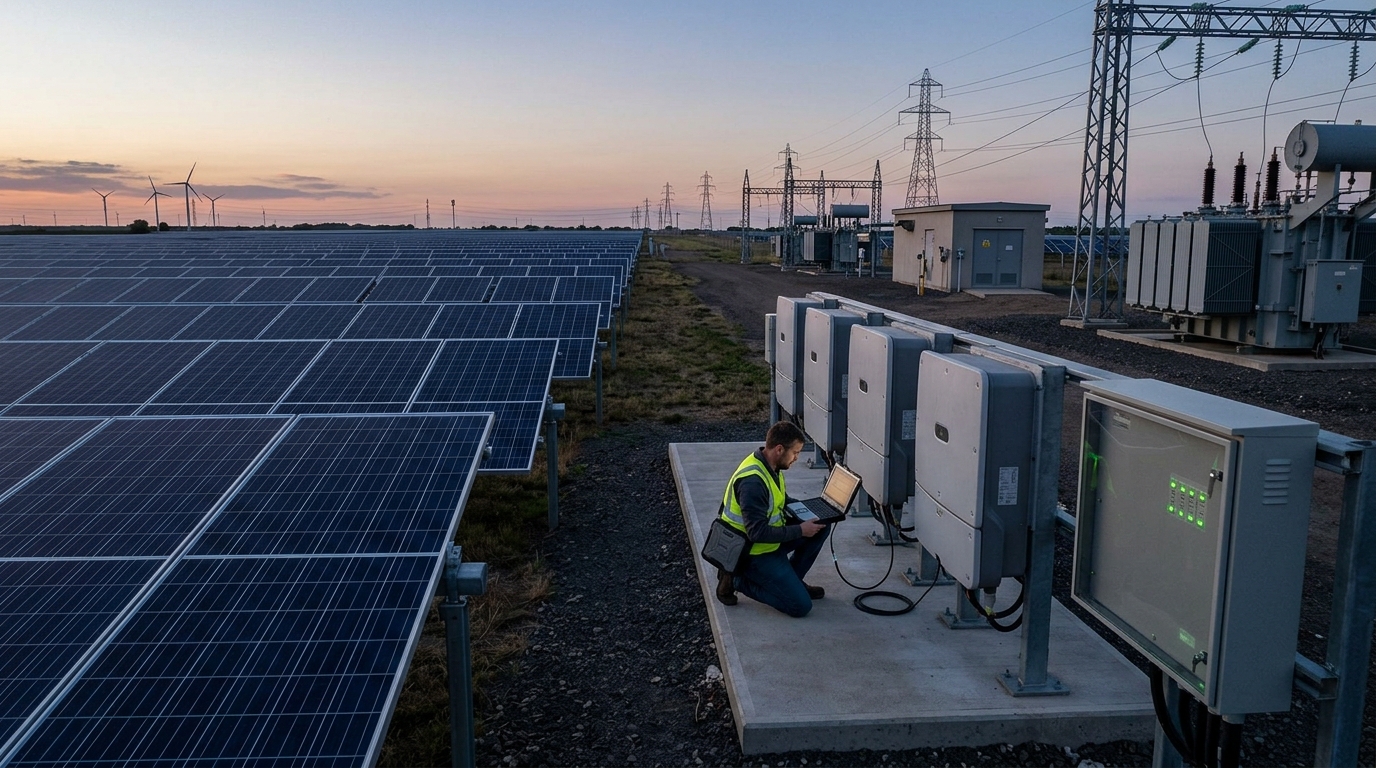
Utility-scale solar farms convert direct current from panels into alternating current through inverters before that power reaches the regional grid. For decades, those boxes were purely passive hardware. GE Vernova changed that equation in September 2024 when it launched its FLEXINVERTER 2000 Vdc, a unit that can deliver up to 6.0 MVA output power and can boost power output by 30% inside the same physical footprint. The efficiency ceiling at 40°C is rated at 98.4%.
Then in May 2025, GE Vernova extended the platform. It added a 1.5kV silicon carbide variant built specifically for utility-scale battery storage, while expanding the 2kV solar version to IEC markets outside North America. Manufacturing shifted to Pittsburgh and Chennai, with Pittsburgh alone adding more than 270 jobs and roughly $10 million in new facility investment. These are not incremental product refreshes. They reflect a deliberate push to own both the conversion hardware and the intelligence layer running on top of it.
Where Software Takes Over
The intelligence layer is GridOS. At Orchestrate 2026 in June, GE Vernova introduced GridOS for Transmission, a unified platform pulling together near real-time operations, digital dynamic line rating, wide-area monitoring, and renewable forecasting into a single control environment. The stated aim: shorten control-room decision cycles and let operators run closer to actual system limits without sacrificing stability.
That matters for solar and wind integration because renewable generation is inherently volatile. A passing cloud bank or a wind lull can swing output by hundreds of megawatts in minutes. Traditional grid management treats those swings as problems to absorb after they happen. GridOS, paired with software-defined inverters that can dispatch reactive power at any hour, attempts to anticipate and route around instability before it propagates. GE Vernova’s Orchestrate 2026 materials describe autonomous grid-edge operations concepts designed to detect, isolate, and restore faults faster than traditional approaches.
The Financial Case
GE Vernova reported Q1 2026 orders of $7.1 billion, up 86% organically, with a book-to-bill ratio of approximately 2.5. By Q2, Electrification revenues reached $3.637 billion, up 68% year-over-year. Full-year 2026 guidance now sits at $45.5 to $46.5 billion in revenue. The company says it has accumulated more than 30 gigawatts of total global installed base and backlog for its inverter technology, and it also says its technology base helps generate approximately 25% of the world’s electricity.
Risks Worth Watching
The inverter business faces margin pressure from Chinese competitors who have aggressively cut pricing on commodity central inverters. Tariff exposure on imported components could squeeze the Pittsburgh ramp. And GridOS for Transmission is still early: integrating legacy utility SCADA systems with a modern software layer rarely goes smoothly or on schedule.
Earnings land October 28, 2026. The grid software revenue line and Electrification backlog conversion rate are the two figures worth watching most closely. If GridOS wins are showing up in services revenue alongside hardware, the software-defined inverter story stops being a product announcement and starts being a margin story.