
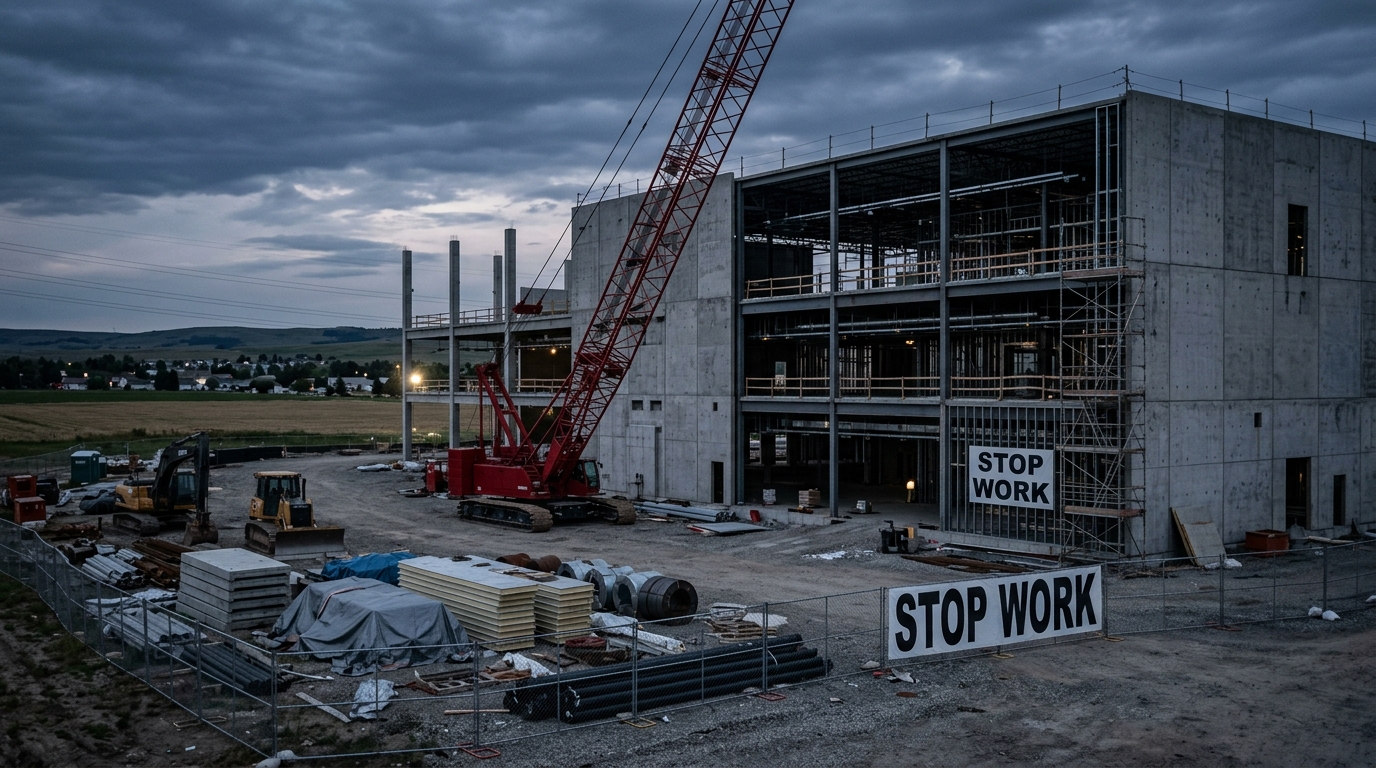
The number that should reframe how traders think about AI infrastructure arrived Monday from Heatmap News: at least $260 billion in US data center investments were canceled in 2026 after sustained local opposition, according to previously unpublished Heatmap Pro data. The pace is accelerating. About $130 billion, roughly half the full-year total, was canceled in the three months ending September 30, and in dollar terms, that single quarter exceeded every data center cancellation recorded in all of 2025.
Roughly $1 trillion in additional data center investment now faces some kind of sustained or meaningful local opposition, and about half of all projects that have met local backlash this year were ultimately canceled. Heatmap noted its figures are likely an undercount, since only about 60% of data center projects disclose the size of their planned investment, especially early in the proposal stage when opposition is most likely to succeed.
The timing is pointed. This data landed the same week Samsung released preliminary Q3 guidance showing operating profit up 782.5% year over year, driven by AI chip demand. Strong chip results have become the reflex argument that AI infrastructure spending is on track. The cancellation data is the rebuttal: demand at the silicon layer can still be robust while the physical layer, permits, power hookups, land use approvals, falls apart beneath it.
The Infrastructure Names Already Feeling It
The capex commitments from Amazon, Google, Meta, and Microsoft are not in question. After Q2 earnings in July, Amazon raised its 2026 guidance to roughly $220 billion, Alphabet moved to $195-205 billion, Meta raised its range floor, and Microsoft guided to roughly $190 billion on a calendar-year basis. Combined, the four hyperscalers are tracking toward $735-745 billion of capital spending for the year. The problem is not the budget. The problem is where projects are physically landing.
Most canceled data center projects are terminated because they fail to secure a local permit or face a hostile local government action. Hundreds of US counties and towns now maintain a ban or moratorium on data center construction. Data Center Watch, which tracks local data center activity, described this as “a structural shift rather than a cyclical spike,” noting that communities have internalized an opposition playbook and the number of active opposition groups more than doubled to 833 across 49 states.
That structural shift matters to names outside the hyperscalers. Vertiv (VRT), the purest play on data center power and cooling, closed at $246.49 on October 7, down 2.63% on the session. That sits well below its June peak near $335 per Digrin price data. The stock has a beta above 2, which means its volatility amplifies any reassessment of AI buildout timelines. Coverage increasingly emphasizes execution risk after Q2 timing issues, and valuation remains a central debate because the stock still trades at a premium multiple.
Digital Realty (DLR) is a different kind of exposure, a REIT that depends on winning permits and building into new markets. Digital Realty’s Q2 backlog at its share reached $1.4 billion, and the company said total backlog at 100% share was $1.9 billion. Signed leases mean nothing if sites cannot break ground. DLR reports Q3 earnings October 29, and permit-constrained delivery timelines will be the question management cannot easily sidestep.
Where the Trade Sits Now
The bull case for the AI capex complex has always rested on two legs: hyperscalers keep spending, and supply chain can keep up. The first leg is intact. The country’s largest technology companies are still expected to spend more than $800 billion this year investing in data centers and artificial intelligence. The second leg is where the fracture is forming. Local opposition is not a quarterly blip, it is compounding, with organized resistance groups doubling from 396 at year-end 2025 to over 800 by mid-2026.
Traders positioned in power, cooling, and construction names on the assumption that every committed dollar would find a home are now carrying more permitting risk than they priced. The Q3 cancellation surge is the strongest evidence yet that the gap between announced spending and buildable sites is widening. Watch DLR’s October 29 earnings call for guidance on site delivery timelines, and treat any Vertiv commentary on order-to-revenue conversion as the forward indicator for whether the AI capex trade still has both legs under it.