
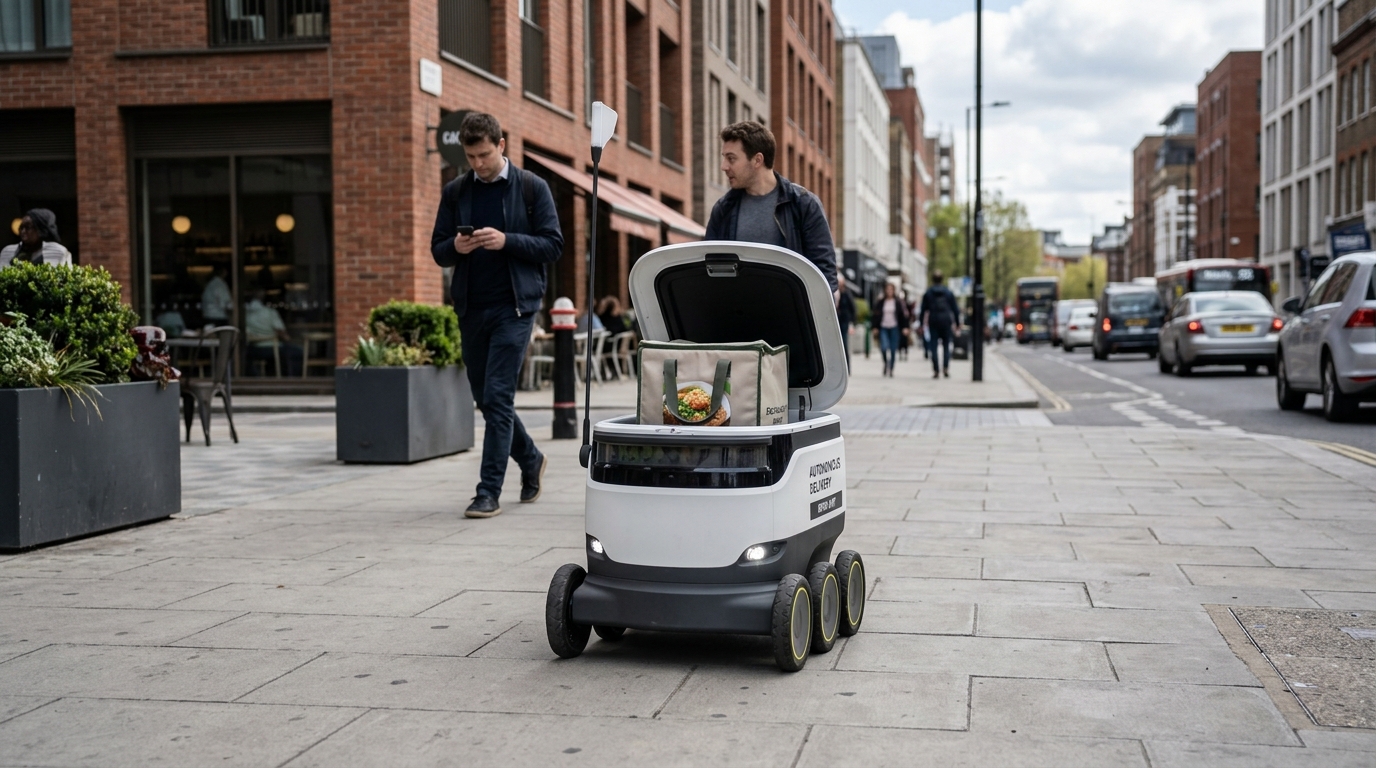
The sidewalk delivery robot has a marketing problem. Barclays published a widely cited analysis in April 2026 projecting that autonomous rovers could eventually deliver a food order for $1. That number traveled fast. What traveled slower was the next line: autonomous delivery currently costs $5 to $7 per drop in early-adoption markets where autonomous delivery is already operational, which Barclays said is $3 to $4 cheaper than conventional rider delivery in higher-labor-cost areas but nowhere near the headline figure.
The gap between today and the $1 target is not a hardware problem. It is a density problem, and the industry’s most transparent operator just proved it.
Serve Robotics has deployed more than 2,000 robots across the U.S. as of Q2 2026, completed over 1.8 million deliveries, and posted Q2 2026 revenue of $3.2 million, up 404% year-over-year. But only 792 robots were daily-active on average during that quarter, and the company cut its full-year guidance to $9 to $10 million from an earlier outlook of roughly $26 million.
That guidance cut is the single most important data point in the autonomous delivery story right now. It isolates the real bottleneck: utilization, not hardware. The hardware problem is largely solved. The utilization problem is not.
The mechanism is straightforward once you see it. New robots are inefficient in unfamiliar territory. Per-delivery cost declines only as robots accumulate route familiarity in a given neighborhood. Scale the fleet before density supports it, and unit economics deteriorate before they improve. Serve’s own investor materials describe the goal clearly: $8 to $10 per delivery is the status quo; sub-$1 is the expected delivery cost at scale. Getting from one to the other requires robots working known streets at high utilization, not sitting idle in depots.
The Gen-3 platform does reduce hardware costs. Introduced in 2025, Gen-3 robots feature a 65% reduction in manufacturing costs alongside a 15% increase in cargo space and 67% more battery capacity. The company also expects each robot, at full utilization, to pay for itself in under one year. The word “full” is doing considerable work in that sentence.
The investment question is not whether robots will eventually win the economics argument. They almost certainly will, once per-neighborhood density crosses a threshold where route learning compounds and deadhead miles collapse. Delivery density is central to robot economics. More orders in the same geography improve utilization and reduce deadhead travel. The question is how long that process takes city by city, and whether the capital required to sustain the learning curve outlasts investor patience.
Autonomous delivery penetration sits at less than 1% of global food delivery orders today, according to Barclays research cited by PYMNTS in April 2026. The structural case is real. The timeline is not the one the projections imply.