
The central laboratory is not disappearing. But its monopoly on high-sensitivity blood analysis is cracking, and the companies holding the pick-and-shovel position inside that crack are worth watching right now.
- Global microfluidics market estimated at $27.3 billion in 2026, on a path to $46.5 billion by 2033 at a 7.9% CAGR.
- Blood biomarker tests raised substantial capital across multiple disclosed deals in the 12 months through July 2026, representing a majority share of biomarker testing capital raised in the period.
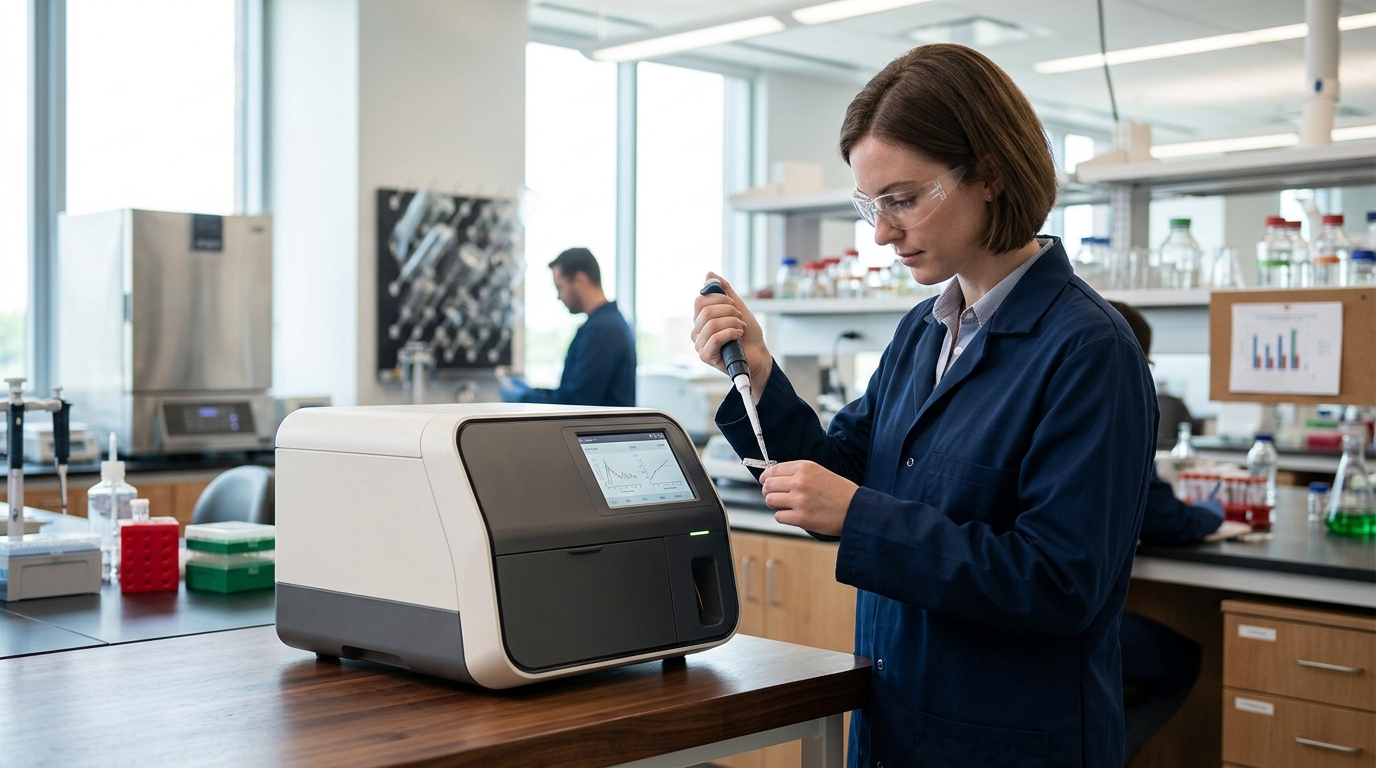
- bioMérieux agreed to acquire SpinChip Diagnostics for a total enterprise value of €138 million; SpinChip’s benchtop analyzer is designed to deliver results in under 10 minutes from a drop of blood, with performance comparable to lab testing.
- Danaher’s diagnostics segment posted $9.94 billion in full-year 2025 revenue; in Q2 2026, diagnostics core revenue grew 2%, and core growth excluding respiratory testing was about 4.5% to 5%.
- Danaher closed its Masimo acquisition on June 10, 2026, deepening its acute-care footprint alongside Beckman Coulter and Cepheid.
- Microfluidic sensor chips are forecast to grow at low double-digit CAGR through the mid-2030s, with North America typically cited as a leading region.
The Compression Trade
The clinical pitch for desktop microfluidics is not just speed. It is the elimination of transport lag. A whole-blood troponin result that takes 45 minutes in a central lab, including courier time and queue, can be returned in 10 minutes at a nurse station. For a chest-pain patient in an emergency department, that compression changes the treatment decision. SpinChip’s platform, now inside bioMérieux following a January 13, 2025 agreement at €138 million, initially targets high-sensitivity troponin I, with additional assays expected to follow. The company said it expected to lodge an application for CE marking under the IVDR before the end of 2025, with a first product launch expected in 2026.
That is one company. The architecture of the broader market is more fragmented, and that fragmentation is the opportunity traders need to map.
Who Owns the Infrastructure
Danaher sits at the institutional center of this market. Its diagnostics division, which houses Beckman Coulter, Cepheid, Radiometer, and now Masimo, generated $9.94 billion in 2025 revenue. Cepheid’s non-respiratory business posted low double-digit growth in Q2 2026, led by its Multiplex GI panel and hospital-acquired infection assays. Danaher’s full-year core revenue guidance sits at 3% to 4% growth, with diagnostics among the segments most insulated from cyclical pressure.
The smaller end of the market is where the structural disruption lives. San Diego-based Genalyte, with roughly $142 million raised including a 2021 Series E led by Verily, has built the Maverick platform around silicon photonic biosensors capable of running multiplex assays in roughly 15 minutes. Athelas has reported major financings in recent years and is often cited at roughly $150 million of total funding, applying automated cell counting and software-driven workflows to near-patient monitoring. Neither is public. Both represent the type of clinical validation asset that larger strategic buyers, bioMérieux’s SpinChip playbook being the template, are actively pricing.
Technical and Scenario Framework
The reimbursement bottleneck is the primary execution risk for any desktop diagnostic company. FDA clearance and CMS coding determinations add 18 to 36 months of non-revenue time after a platform is technically validated. Investors pricing these assets on revenue multiples need to anchor to that clock.
Bull case: Expanded FDA 510(k) pathways for combination microfluidic panels accelerate 2027 launches, driving revenue inflection at private players and multiple expansion for diagnostics conglomerates. DHR trades through $320.
Base case: bioMérieux’s SpinChip program reaches meaningful European volume by Q1 2027. Danaher’s diagnostics segment hits the high end of its 3% to 4% core growth guide. The market continues consolidating sub-scale private platforms at €100 to €200 million enterprise values.
Bear case: Reimbursement coverage decisions for point-of-care high-sensitivity immunoassays stall in both the U.S. and Europe. Hospital procurement freezes cut device placements. Diagnostics segment margins compress for the large-cap players as capex outlays for POC expansion outpace revenue.
The key level to track is not a stock price. It is bioMérieux’s SpinChip commercial launch cadence and whether the first reimbursement code is established in the EU. That binary determines whether this technology cycle resets in 2027 or 2028. Position sizing and stop discipline matter more than conviction here. The data is compelling. The timing remains the variable.