
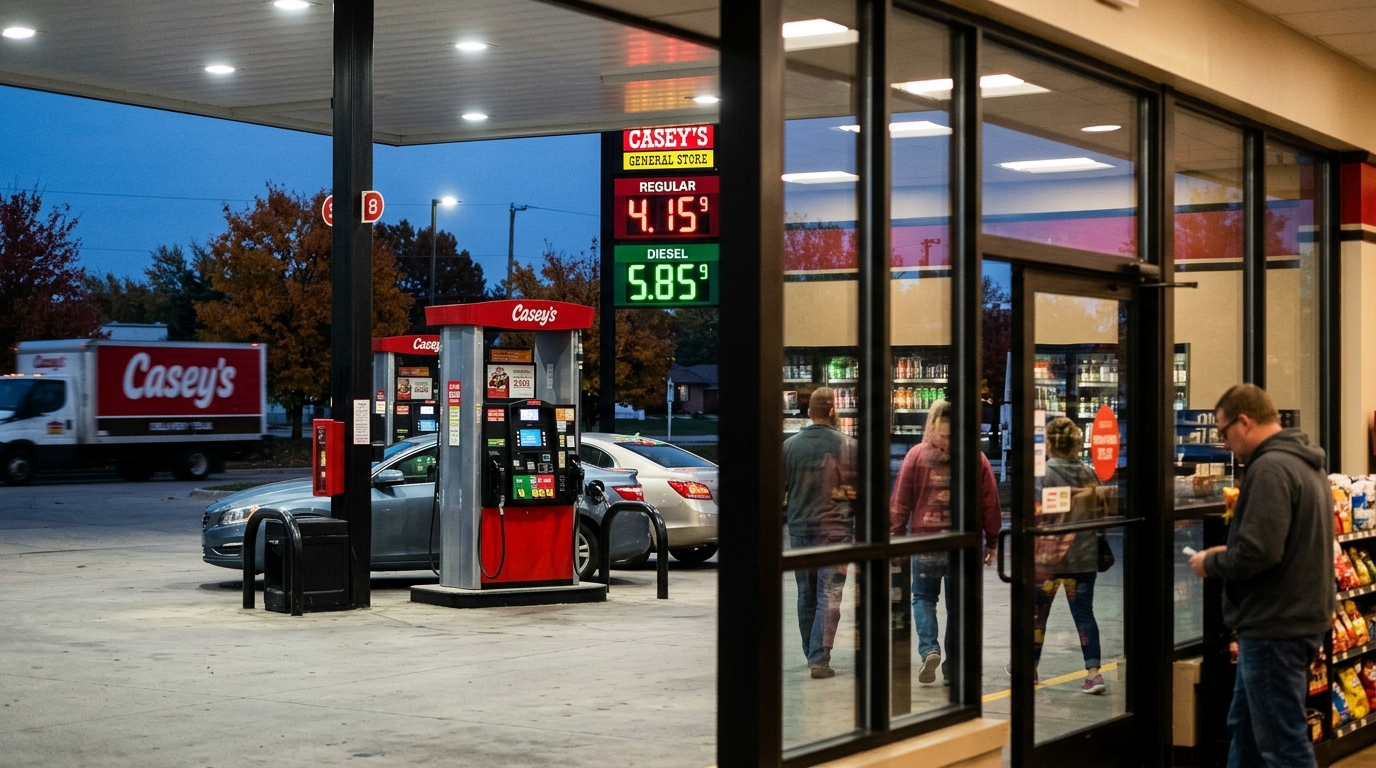
Here is a counterintuitive fact worth sitting with before Tuesday night: the same fuel prices squeezing American drivers at the pump are very likely padding Casey’s General Stores’ profit per gallon. Gasoline reached $4.15 a gallon ahead of Labor Day weekend, according to AAA, while diesel hit an all-time record of $5.85 a gallon, eclipsing the prior mark set in June 2022. For consumers, those numbers are painful. For a convenience-store operator that sets retail fuel prices faster than its wholesale costs rise, they can be a windfall.
Casey’s will release fiscal first-quarter 2027 results after the market closes on September 8, with a conference call the following morning at 7:30 AM central. Analysts expect about $6.6 in diluted EPS, up from $5.77 in the year-ago quarter. The company is among the first major retailers to report results that include the late-summer surge at the pump, which makes this a meaningful read on how fuel-market chaos actually flows through convenience-store economics.
Why the Pump Math Is Backwards
Convenience stores make money on fuel through the spread between wholesale cost and retail price, measured in cents per gallon. When prices spike rapidly, operators can temporarily widen that spread because their retail prices outpace the wholesale cost reset. Casey’s fiscal 2026 fuel gross profit ran at 42.6 cents per gallon, and the fuel margin in the fourth quarter alone reached 46.9 cents. Management has said that price volatility can support stronger fuel margins.
AAA said the national average for regular gasoline was $4.15 a gallon heading into the Labor Day weekend, and diesel averaged $5.85. That sustained volatility, running for months rather than weeks, is the specific condition that tends to widen convenience-store fuel margins most reliably.
The Other Side of the Basket
The inside store is a different story. When consumers absorb sticker shock at the pump, they tend to spend less on the way in. Casey’s fiscal 2027 guidance targets inside same-store sales growth of 2% to 5%, with inside margin above 42%. That range is achievable but relatively modest compared to the 5.1% same-store inside sales gain the company posted in Q4 fiscal 2026. Watch whether management narrows or lowers that band on Tuesday, which would signal that fuel-squeezed consumers are pulling back on prepared food and discretionary items.
Casey’s small-community footprint is central to its store economics, generating revenue from retail fuel, grocery and general merchandise, and prepared food, giving it multiple profit levers rather than dependence on one category. The prepared-food push, including the sauced wings expansion now in nearly 850 stores, is a margin-rich bet on the inside basket holding up. High-priced fuel quarters test that bet directly.
Bull Case, Bear Case
The bull argument is straightforward: fuel-margin windfalls in a record-price environment, layered on top of a company already guiding for 8% to 10% EBITDA growth and at least 120 new store openings in fiscal 2027, could drive meaningful upside to the roughly $6.6 consensus. Casey’s beat the Q4 fiscal 2026 consensus by about a dollar per share. The company had a return on equity of 18.73% in that quarter.
The bear case centers on the inside store and valuation. CASY shares are up sharply over the past 52 weeks, and the stock sits around $755 heading into the report, well off the 52-week high of $927.85 but carrying a forward earnings multiple above 35x. If inside same-store sales disappoint, or if management signals that wallet-stressed consumers are trading down from prepared food, the stock has room to give back more ground regardless of how strong the fuel line looks.
What to Watch Tuesday Night
Three figures will determine the post-earnings reaction. First, fuel margin in cents per gallon: anything above the 46.9 cents Casey’s posted in Q4 fiscal 2026 would signal the record-price quarter delivered exactly what the bull case required. Second, inside same-store sales: a print below 2% would reopen questions about consumer health in the rural Midwest markets Casey’s dominates. Third, full-year guidance: the full-year EPS consensus sits at $21.14. Any revision to that figure, up or down, will move the stock more than the quarterly beat or miss.
Casey’s is a company that wins when the fuel market is chaotic. It just lived through the most chaotic fuel stretch in years. Tuesday night is where that thesis gets scored.