
Here is the question most coverage of Nvidia’s Lancium deal is missing: what exactly is $3 billion buying?
The obvious answer is a 20% stake in a power infrastructure developer. The real answer is something far harder to recreate. Lancium secured ERCOT-eligible interconnection positions at multiple gigawatt-scale Texas sites before the deadline for the legacy Large Load Interconnection Study process, and as of end of day July 10, 2026, that specific path is closed: ERCOT moved large-load projects into the new Batch Zero framework and ended the legacy process.
Why This Deal Matters Now
On August 8, 2026, The Information reported that Nvidia plans to invest up to $3 billion in Lancium, a developer focused on power infrastructure in Texas. The report said Nvidia would invest an initial $2 billion for a stake of roughly 20%, with an additional $1 billion tied to milestones.
The same report put Lancium’s valuation at around $10 billion. That values grid-connected Texas acreage at a premium that would have seemed absurd three years ago. Today it reflects a simple supply and demand problem: the queue to get onto the Texas grid is effectively frozen.
ERCOT has said it is considering about 474 gigawatts of large-load connection requests and state officials have said most new requests are data centers. Most of those requests will go nowhere. Lancium’s advantage is the maturity of its grid work and site development.
The Investment Thesis
Nvidia is the dominant seller of AI chips. It has roughly 80% market share in GPUs used for AI, more than $500 billion in orders for Blackwell and Rubin, and fiscal 2026 revenue of $215.9 billion. What it cannot control is whether customers can actually turn those chips on at scale.
Nvidia has been increasingly explicit that power availability and grid constraints are becoming limiting factors for AI deployment. The Lancium deal is the clearest expression yet of that shift.
While Nvidia remains the dominant supplier of AI GPUs, an ownership stake in Lancium would also give it exposure to one of the industry’s most significant constraints: the availability of land with reliable, large-scale electricity access.
Nvidia’s stake would align the dominant AI chip supplier more directly with the infrastructure that consumes those chips, creating a powerful incentive loop: more data centers mean more demand for Nvidia systems, while an equity position in the facilities could help secure deployment sites for its hardware.
The Business Behind the Asset
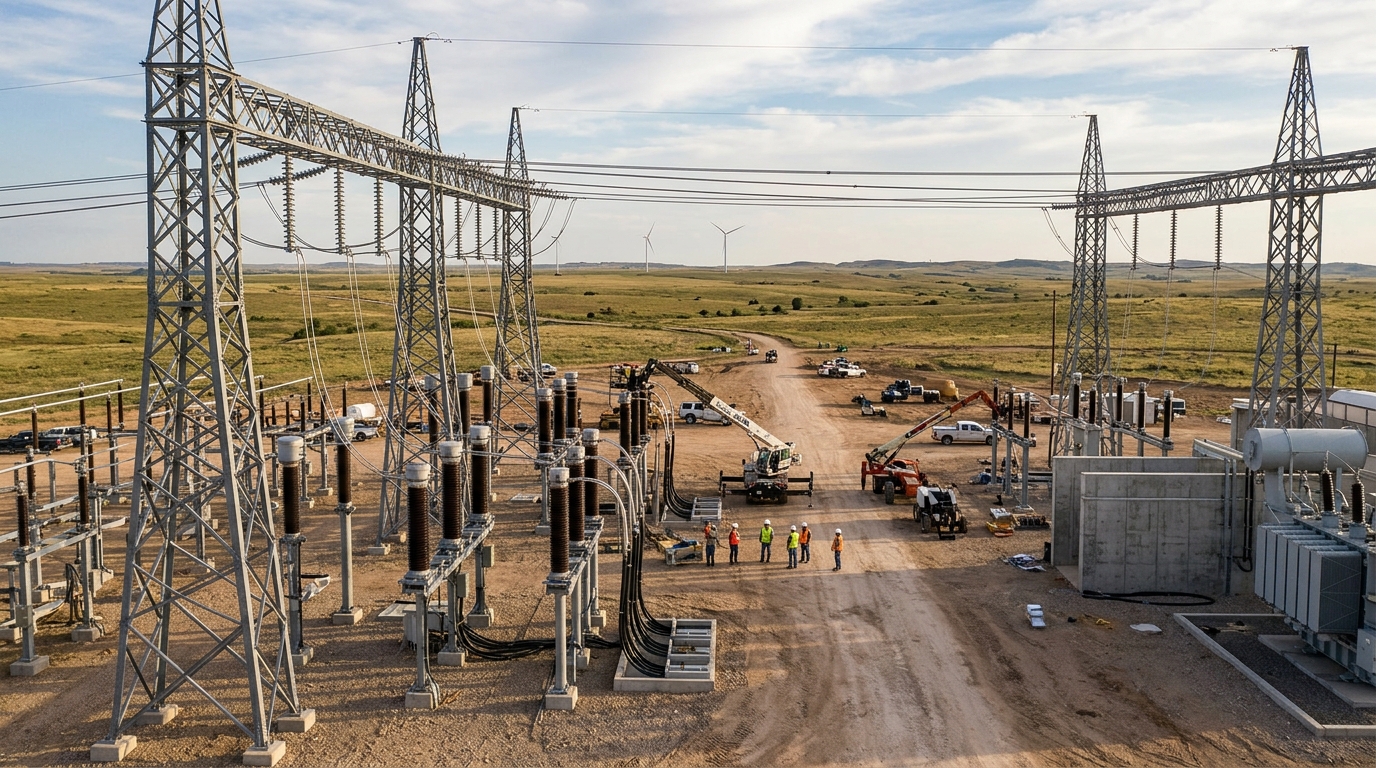
Lancium is not a traditional data center operator. Unlike traditional data center operators, Lancium specializes in developing large-scale sites with access to high-capacity electricity. The campus combines land, transmission infrastructure, and grid connectivity, allowing developers to deploy AI data centers more quickly than greenfield projects that require new power infrastructure.
The company built early visibility through flexible-load and bitcoin mining use cases, and has increasingly positioned itself around AI data center infrastructure. According to The Information, the company has secured and developed 4 gigawatts of power resources on the Texas grid, with another 15 gigawatts of interconnection projects in progress.
The recent expansion pace accelerates that picture. Lancium and Crusoe announced a 1.0 GW AI data center campus in Childress on July 15, and QTS Data Centers and Lancium announced a proposed data center campus near Turkey, Texas, expected to bring more than $10 billion in capital investment to the region. Two gigawatt-scale site announcements in one week, each built on grid work initiated before the July 10 cutoff for the legacy large-load process.
What’s Changing
The demand context makes Lancium’s grid position genuinely scarce. ERCOT has told lawmakers that statewide electric demand could reach about 175,000 megawatts by 2032, almost double a recent monthly record. The Texas grid keeps setting summer highs.
Against that backdrop, pre-approved capacity is the scarce input. Lancium is in an unusually strategic position. It controls not just acreage but access to power connections that can take years to secure. Nvidia, by taking a 20% stake and tying a third of its investment to milestone-based grid hookups, is essentially paying for an option on that scarcity.
This also fits a broader pattern. Nvidia disclosed that the value of its non-marketable equity securities rose from about $22 billion to about $43 billion in the quarter that ended April 26, 2026. The Lancium deal is one node in a larger infrastructure financing strategy.
The capital is expected to help Lancium expand its operations as it explores a potential initial public offering in 2027. That IPO timeline matters. If Lancium lists, Nvidia’s 20% stake becomes a liquid position, and the company’s grid portfolio becomes a publicly traded benchmark for exactly the kind of infrastructure scarcity the AI buildout is creating.
The Risks
The circular logic deserves scrutiny. When Nvidia is simultaneously an equity investor in and a chip supplier to the same AI infrastructure companies, some of the demand for its products is arguably being funded by Nvidia’s own capital rather than fully independent customer demand.
The deal also deepens exposure to the risks that come with giant campuses, including higher electricity demand, pressure on local grids, water use concerns, and fights over tax incentives. Texas regulators are not passive observers. Gov. Greg Abbott has directed the Public Utility Commission of Texas and ERCOT to deny grid connection to projects that do not meet state requirements, and state officials have discussed auditing projects in the queue.
There is also execution risk baked into the milestone structure. Nvidia could provide another $1 billion if Lancium meets specified thresholds, including milestones related to grid hookups. The transaction structure links one-third of Nvidia’s potential investment directly to the physical infrastructure required to energize new computing capacity. Grid hookups in Texas are getting harder, not easier, even for advanced projects.
What Investors Should Watch Next
Three things will confirm or challenge the thesis over the next 12 months. First: watch the gigawatt count. Separate reporting has said Blackstone invested more than $500 million in Lancium and that Lancium has aimed to bring multi-gigawatt sites online by about 2028. Whether those targets hold will determine whether the $10 billion valuation was earned or assigned prematurely.
Second: watch the milestone payments. The extra $1 billion Nvidia committed is contingent on grid hookups. Every additional interconnect Lancium brings online converts contingent capital into confirmed equity, which confirms the real-world execution behind the investment thesis.
Third: watch the IPO timeline. Market observers have noted that this capital injection could help Lancium accelerate its business expansion while it evaluates a potential IPO as early as 2027. A Lancium IPO would be a rare direct public market look at the value of advanced ERCOT grid access as an asset class, and it would either validate or reset the $10 billion valuation attached to this deal.
Bottom Line
Nvidia is not becoming a utility. It is doing something more targeted: buying a toll position on the one input every chip customer needs but nobody can build fast enough. Grid connections are the new fab capacity, and Lancium holds some of the most valuable advanced connections in the United States. The $3 billion price tag is not for the land or the wire. It is for the time advantage and regulatory progress behind both, at the exact moment the legacy ERCOT large-load entry path ended on July 10, 2026. That is a rational bet, with identifiable risks and a 2027 IPO as the moment of reckoning.