
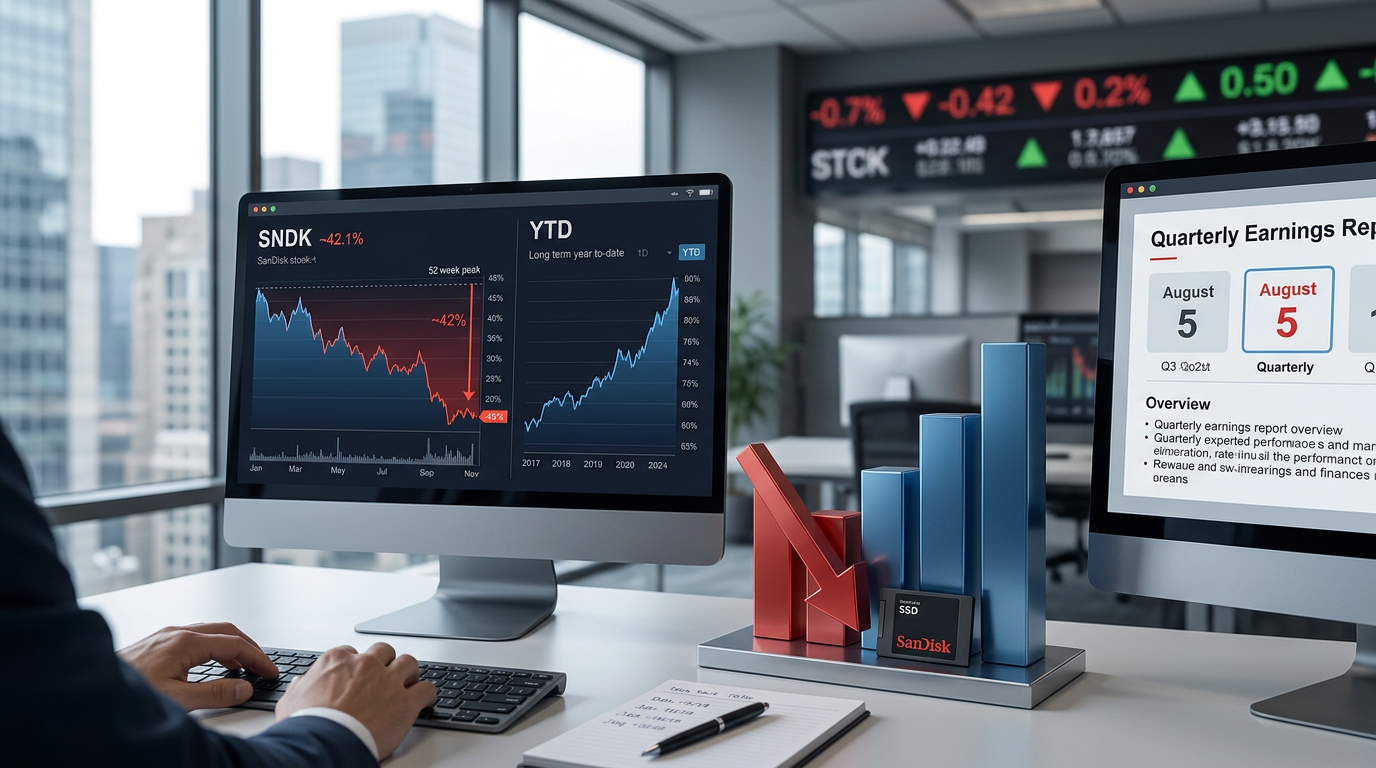
Here’s where I’m at with SanDisk right now. The stock is up somewhere around the mid-400% range year-to-date, putting it at (or near) the top of the S&P 500 leaderboard in 2026. And yet it has fallen roughly 42% from its 52-week high in just a few weeks. If you only looked at a one-month chart, you’d think something broke. The fiscal Q4 earnings date on August 5 is the first real chance to find out.
What’s interesting is that nothing fundamental actually changed. The selloff has looked like a mix of broader memory/chip sector profit-taking, macro/geopolitical risk headlines, and one very well-timed Argus initiation at Hold that acted like a match in a dry forest. The underlying NAND supply and demand math hasn’t obviously shifted.
What the Business Actually Did
Let’s put some numbers in front of this. In Q3 fiscal 2026, SanDisk reported revenue of $5.95 billion, up 251% year-over-year. Datacenter revenue, specifically, grew 645% year-over-year and 233% sequentially in a single quarter. GAAP net income was $3.615 billion. Non-GAAP EPS came in at $23.41.
For Q4, management guided revenue of $7.75 billion to $8.25 billion with non-GAAP EPS of $30.00 to $33.00. That midpoint would represent another massive sequential step from an already historic quarter. The company has signed five long-term supply agreements under its “New Business Model” framework since becoming independent following its separation from Western Digital on February 24, 2025.
SanDisk has also disclosed about $41.6 billion of remaining performance obligations tied largely to long-term customer agreements (as of early April 2026). That’s not speculative. That’s visibility most semiconductor companies would love to have.
What Goldman Is Actually Saying
On July 5, Goldman Sachs analyst James Schneider raised his price target from $1,200 to $2,200 and reiterated Buy. His non-GAAP EPS estimate for calendar year 2026 sits roughly 30% above Street consensus. He cited continued NAND supply tightness and raised his estimates specifically on improving contract pricing trends.
The methodology is worth understanding. Goldman reduced its multiple from 22x to 20x on a higher earnings base, and the EPS estimate doubled. That’s not valuation inflation. That’s a fundamental earnings power revision that most of the Street hasn’t fully absorbed yet.
Evercore’s Amit Daryanani went further, raising his price target from $1,400 to $3,100 while maintaining Outperform. The consensus average target across 23 analysts implies more than 58% upside from recent levels.
The Real Risk Here
Slight tangent, but it matters. Memory has always been one of the most cyclical businesses in semiconductors. When NAND pricing peaks, it doesn’t drift down. It crashes. Morningstar does not assign an economic moat to SanDisk, arguing that NAND flash is a commodity and that in periods of oversupply, margin compression can be severe. That’s a legitimate counterpoint.
But here’s the thing. The current environment may be structurally different. AI infrastructure demand is not consumer-driven. Cloud providers are signing multi-year agreements because they cannot afford spot-market exposure at this scale. SanDisk’s new business model, featuring those long-term agreements, is providing earnings visibility the company historically never had. That matters when you’re trying to decide whether this cycle looks like 2018 or 2022.
NAND supply elasticity is limited through at least 2027 by most estimates. SanDisk has said these long-term agreements are expected to account for more than one-third of its bit shipments in fiscal 2027. The data center business grew 233% quarter over quarter in a single period. These are not consumer gadget numbers.
The August 5 and August 13 Window
Two dates are on the calendar. August 5 is earnings. August 13 is Investor Day, where management is expected to quantify the multi-year long-term agreement pipeline and set long-term financial targets for the first time as a fully independent company.
SanDisk has rallied after every major earnings report since its spin-off. The track record is consistent. The question is whether expectations are now too high given that the stock has already returned hundreds of percent this year, or whether Goldman’s view, that the Street is still 30% below on EPS, is the number that actually matters.
At roughly 22x forward earnings, the stock trades below the sector average despite far outgrowing its peers. The valuation picture, as counterintuitive as it sounds for a name up several hundred percent this year, is not extreme.
The part people skip is this: a ~40% pullback in a name up several hundred percent is not a broken story. It’s a repricing of momentum, not fundamentals. Those are two very different things. August 5 will tell us which side of that argument is right.