
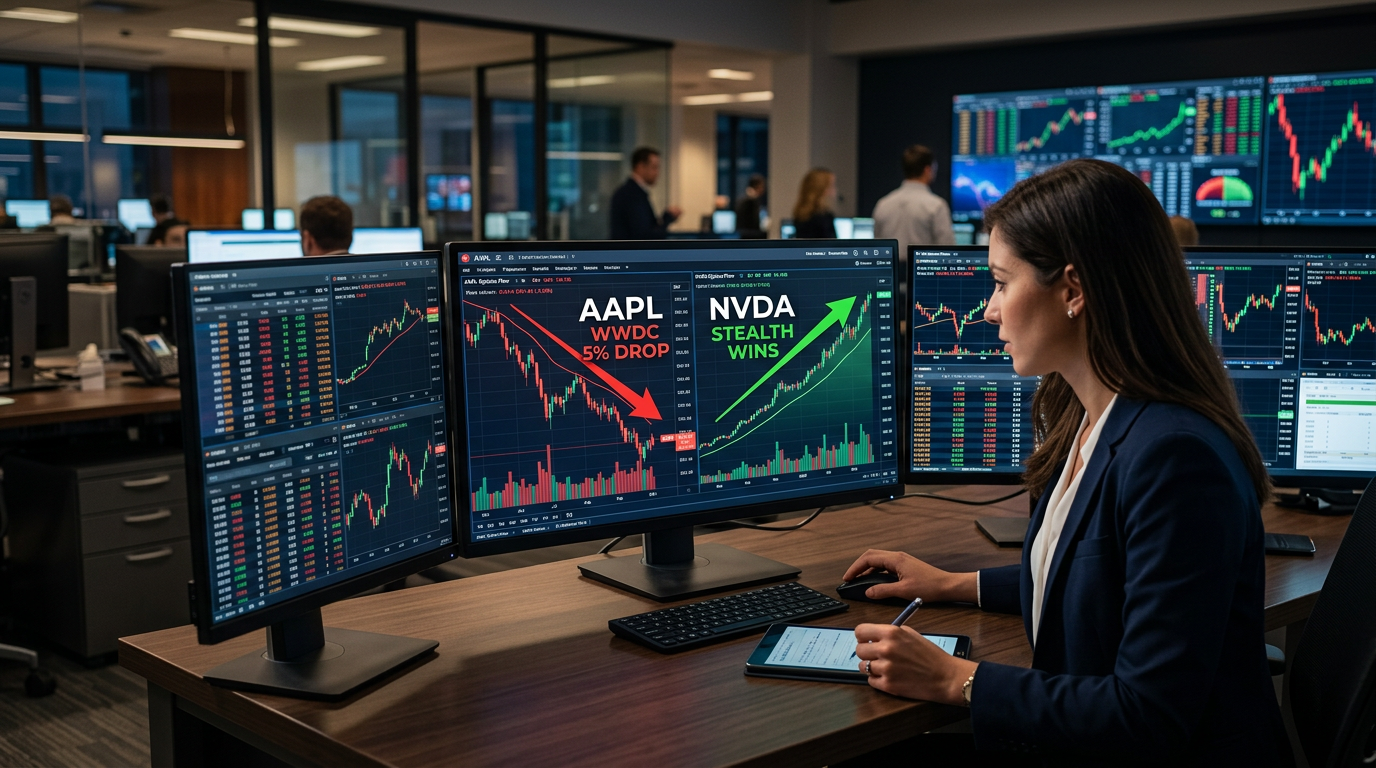
Here’s the setup nobody quite expected coming into this week.
Apple held its annual Worldwide Developers Conference, unveiled a revamped AI-powered Siri, introduced iOS 27, macOS Golden Gate, and a new Apple Intelligence platform. The stock initially spiked to around $317 intraday — then reversed hard, closing Monday at $301.54 and sliding another 3.6% on Tuesday. Total trading volume hit 76.6 million shares, roughly 68% above the three-month daily average. The message from the market was clear: impressive announcements, unclear monetization timeline.
Investors appeared unimpressed that Apple did not set a firm release date for Siri AI. And there’s a nuance here worth unpacking. Apple’s new Apple Intelligence platform is being powered — at least in part — through Google Cloud infrastructure running on Nvidia GPUs. Apple isn’t buying those chips directly. It’s accessing them via its Private Cloud Compute expansion into Google’s data centers. Which means Nvidia wins the architecture endorsement without a direct purchase order, at least not yet.
Two Stocks, Two Very Different Stories
Nvidia ticked up on the Apple tie-up news. The endorsement matters — not necessarily for immediate revenue, but because it validates Nvidia’s hardware as the default backbone for AI workloads even at the consumer device level. Apple, a company that historically refuses external processors, chose Nvidia chips — even indirectly — because its internal silicon couldn’t meet frontier model requirements. That’s a reputational win for NVDA that the options flow is quietly acknowledging.
As of June 9, NVDA traded between $199.34 and $211.39, closing near $207.77 on volume of 178.78 million shares. The 52-week range sits between $140.86 and $236.54 — which means the stock is in the middle of its annual range, not at extremes. Nvidia’s market cap stands at approximately $5 trillion as of June 10. The analyst consensus remains Strong Buy with 38 analysts, average price target near $298.
Apple’s story is more complicated right now. AAPL last reported earnings April 30, posting a +3.2% stock gain the following day, and has drifted roughly +10.9% higher since — trading up to a recent high of $311. The next earnings date is estimated between July 30 and August 3, 2026. With the WWDC selloff pulling shares back to near $301–$310, the stock is now consolidating well below its WWDC intraday spike.
What the Options Flow Is Saying
On June 9 alone, 69.3 million total options contracts traded across the market, with net open interest building by 7.25 million calls versus 5.08 million puts. Apple and Nvidia were both among the names seeing substantial options growth that session.
For AAPL specifically — ahead of earnings estimated late July — the near-term IV environment remains relatively subdued. Options pricing into the Q4 earnings window will begin building premium as July approaches. Wedbush analyst Dan Ives maintains an Outperform rating with a $400 price target, arguing that Siri and AI monetization potential is “not being factored into the current multiple.” That is a setup where long-dated calls — if purchased while IV remains compressed — carry asymmetric appeal for traders who believe the monetization narrative gets priced in by earnings.
For NVDA, the Apple-Google-Nvidia triangulation adds a consumer narrative on top of an already dominant enterprise story. The new Siri effort ties Nvidia even more closely to consumer-facing services, not just developer and enterprise workloads. That broadens the total addressable market story heading into the August earnings window.
The Structural Trade Framework
If you believe AAPL’s WWDC dip is a buying opportunity ahead of July earnings: A defined-risk call spread targeting the $310–$340 range in the August expiration captures the implied upside window while managing the binary risk of a July earnings miss. IV remains relatively low pre-earnings, making long premium here comparatively inexpensive.
If you believe AAPL’s selloff reflects a genuine AI credibility gap: A put spread in the $285–$300 range into July expiration provides defined-risk downside exposure into earnings if monetization timelines continue to disappoint. The retail crowd on Stocktwits is currently bullish AAPL and bearish NVDA — which means the contrarian read leans the other way.
For NVDA — neutral-to-bullish bias: With the stock mid-range and no near-term earnings catalyst until August, a defined-risk call diagonal — buying longer-dated calls while selling near-term premium — allows participation in any continued AI infrastructure rally while funding the position through short-term IV collection.
The WWDC week ended with a split tape: Apple sold the news, Nvidia captured the narrative. Whether that divergence persists into July earnings season is the central question. The options market is watching both carefully — and the flow tells you which side the institutional money currently favors.