
The easiest read in energy markets this weekend was that the de-escalation trade is intact. Brent crude for January delivery settled Friday at $92.57 a barrel, up 0.64 percent on the day but down 3.41 percent for the week, its third weekly loss in a row. The popular explanation has been a recovering flow of oil through the Gulf. That story ran into the weekend hard.
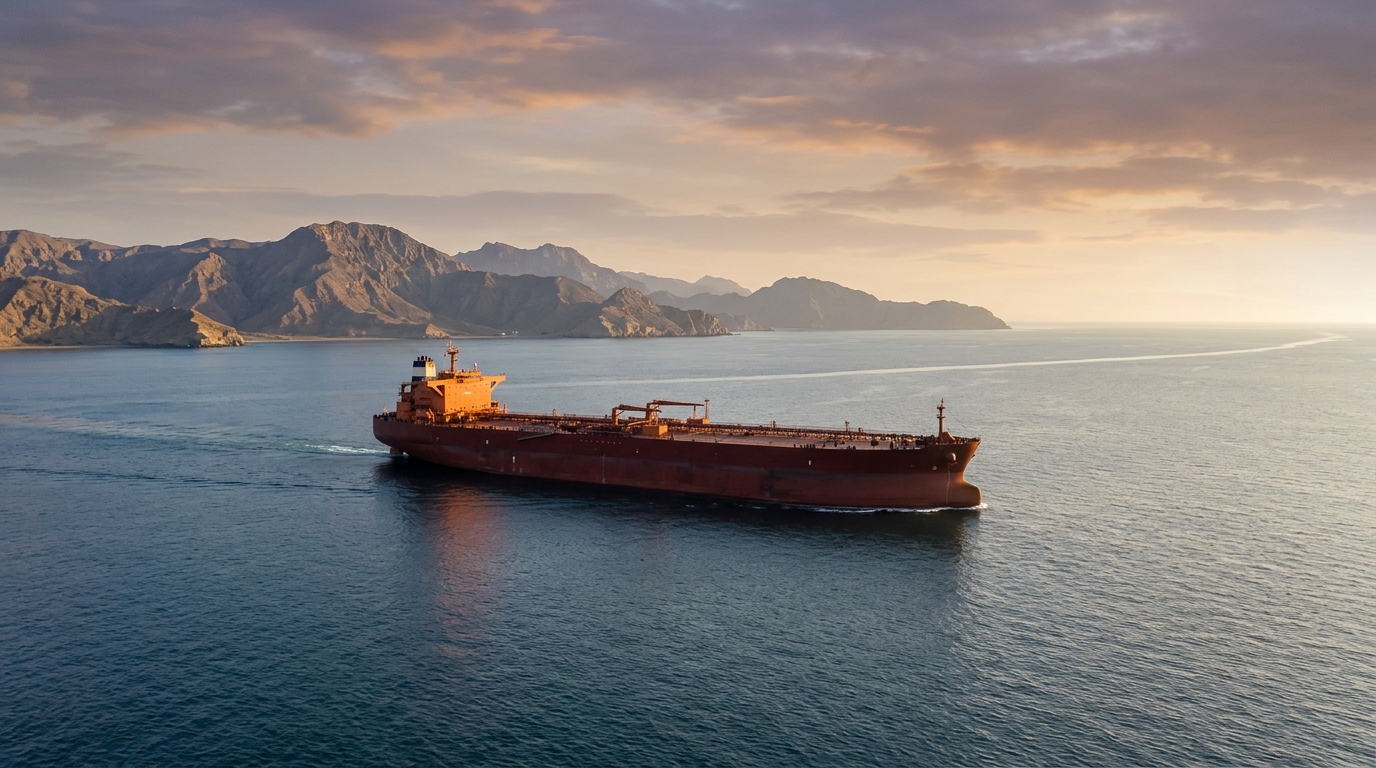
Two tankers sailing outbound through the Strait of Hormuz were hit by unidentified projectiles off Khasab, Oman, on Saturday morning, according to the United Kingdom Maritime Trade Operations. One vessel was struck on its stern north of Khasab; another was hit in its engine room about 17 nautical miles east of Khasab. Iran’s navy said separately that an oil tanker caught fire after hitting a naval mine in a restricted area east of the Strait of Hormuz. Three incidents in one morning. No casualties were reported, but the signal is impossible to miss.
What the Freight Market Already Knew
The tanker rate market had been reading this more accurately all week. The Baltic Dirty Tanker Index, at 4,812, was up by more than 5% on November 19 compared to the day before, and climbed by well over 7% since the start of that week. The index ended the full week at 5,081, up 5.59% from that midweek reading. Freight markets move on physical reality: ships being hit, insurers raising war-risk premiums, charterers bidding harder for vessels willing to run the corridor. Crude futures, by contrast, had been moving on the macro thesis that Gulf supply was recovering and a peace framework was near.
That thesis rests on shaky data. Hormuz crude flows have fallen to about 50% of pre-war levels, with Kpler putting crude moved through the strait at roughly 8.5 million barrels a day in preliminary figures through mid-November. Reported attacks in and around the Strait of Hormuz have been higher in October and November than any previous months since the war between the U.S., Israel, and Iran began in late February. Al Jazeera reported this week that incidents involving tankers had increased sharply, with roughly two dozen reported in the week before Saturday.
Who Bears the Risk
The divergence between crude and freight creates a specific tension for tanker equities, which have been trading their own de-escalation discount. Frontline closed recently at $46.95 against a 200-day moving average near $40, and International Seaways at $105.08 against roughly $87, with the group having given back nearly half its war-premium from peak levels. Teekay Tankers has said it secured fourth-quarter spot rates at levels that put its weighted average fourth-quarter booking rate around $236,000 a day, and the group broadly beat third-quarter expectations. Investors were selling anyway, on talk of sanctions relief that would add supply and on the idea that a deal would drain the freight premium quickly.
Saturday’s incidents directly challenge that reasoning. Each new projectile strike raises war-risk insurance costs, narrows the pool of willing vessels, and lengthens effective voyage times as captains hug the Omani coast or seek escort. IEA Executive Director Fatih Birol said at the agency’s World Energy Outlook release on November 19 that confidence in shipping oil through Hormuz has been “shattered.”
The OPEC+ Complication
The coming week is a countdown to the full OPEC+ ministerial meeting on November 29, which is expected to set 2027 production baselines and quotas. Any decision to hold or cut output assumes the group has a view on where physical flows are headed. Fresh attacks make that assessment harder. If OPEC+ reads the weekend’s events as a reason to hold barrels back, Brent’s slide stalls. If they read the same recovering-supply data the crude market has been trading, the gap between freight and crude widens further.
Risks and Counterpoints
Crude could be right for reasons unrelated to Hormuz transit risk. Despite worsening geopolitical conditions, Brent has been trading near its lowest levels since late August and has fallen by roughly 20% so far in November amid signs of recovering global supply. A large enough non-Gulf supply cushion can offset even sustained chokepoint disruption. And tanker rates are inherently volatile instruments: a single week of reduced attacks could deflate the freight premium sharply.
But the asymmetry is worth sitting with. Freight is priced for a hot Hormuz. Crude is priced for a managed one. Saturday morning made the freight market look like the sharper read. Watch the attack frequency through the week: if the pace of UKMTO attack warnings holds high, the case for Brent catching up to what ships are already telling investors gets considerably harder to dismiss.