
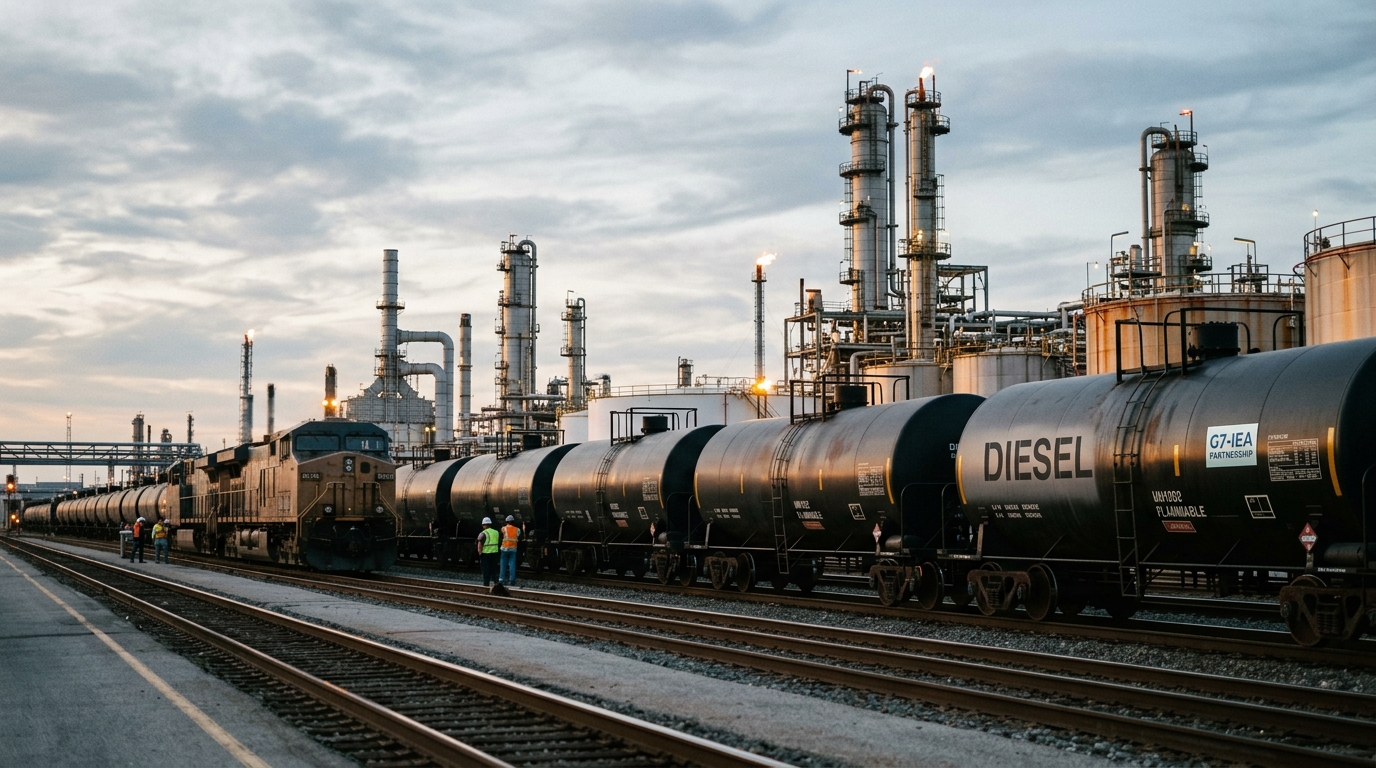
Friday’s G7 videoconference, chaired by Emmanuel Macron, produced the clearest macro signal energy traders have received in weeks. G7 member countries agreed to release 100 million barrels of crude and refined products through the IEA, beginning immediately over four months, including a front-loaded substantial diesel release within the first 20 days by members and partners. The export-ban threat that had rattled Atlantic Basin fuel markets all week is now formally off the table. The deal reaffirmed G7 nations’ commitment to refrain from export restrictions on energy and energy products between member countries.
Brent’s initial reaction told the story. Brent slid on October 2 as the release headline hit, pulling back from a run that had been pressing toward triple digits all week. Crude softened on the headline, as expected. But crude is not where the active trade lives right now.
The Diesel Crack Is the Real Number
The product market has been running a completely separate story from the crude market for months. The U.S. diesel crack spread hit a record $102.20 a barrel in August, signaling that the fuel powering trucks, tractors, trains, and cargo ships is in short supply even as crude has looked relatively calm. That is the dislocation traders need to map before positioning into this week’s resolution.
The G7 release compresses the front end of that spread. A front-loaded diesel draw over 20 days is product-specific supply hitting the market now, not crude that still needs weeks of refinery time to become distillate. For traders long refiner stocks purely on crack-spread expansion, that 20-day window is the countdown clock. Goldman Sachs estimated the release could offset only around half of the recent diesel price rise, with structural limits including refinery lag on crude volumes and ongoing Strait of Hormuz disruption keeping the ceiling on relief low. That residual tightness is the bull’s last argument, but the trajectory is clearly lower for near-term cracks.
Rotate Before OPEC+ Weighs In
The second pressure point arrives Sunday. OPEC+ countries are set to meet October 4 to review market conditions and determine production policy for November. A rollover of current targets is widely anticipated, though the official decision has not yet been confirmed. A hold is already priced in. Any hint of a further increase would compound Friday’s crude softness and put additional pressure on refiner margins from the input side.
The rotation here is within energy, not out of it. Integrated majors like XOM carry less crack-spread sensitivity and more cushion if crude finds a floor near $99. Pure-play refiners are the exposure to trim or hedge before the 20-day diesel window opens in earnest.
Stocks on the Radar
MPC, VLO, and PSX have posted total returns of roughly 57%, 56%, and 47% respectively since June, a run built directly on the crack-spread dislocation that the G7 release now begins to resolve. Valero’s realized refining margin roughly doubled year over year, and Marathon Petroleum’s refining and marketing margin jumped from $17.58 to $36.33 per barrel in Q2. Those are the comps Q3 reporting will be measured against, with VLO due October 22 and MPC on November 3.
The risk is straightforward: crack spreads this extreme historically compress once refiners ramp utilization or a geopolitical resolution reopens flows through Hormuz. A credible diesel release accelerates that compression on a defined schedule. Traders holding refiner longs into the 20-day window are holding a position whose primary tailwind now has an expiry date attached.
Trader’s Action Plan
Watch the weekly EIA on-highway diesel reading as the leading indicator for crack spread direction. A sustained move lower there is the earliest confirmation that the G7 release is actually clearing product into the market. On crude, $99 Brent is the first real test of whether the release broke momentum or merely paused it. OPEC+ Sunday is the next binary. If the group holds targets as expected and Brent stabilizes, integrated names offer a cleaner risk-reward than pure refiners at current levels. The 20-day diesel clock started Friday. Position accordingly.