
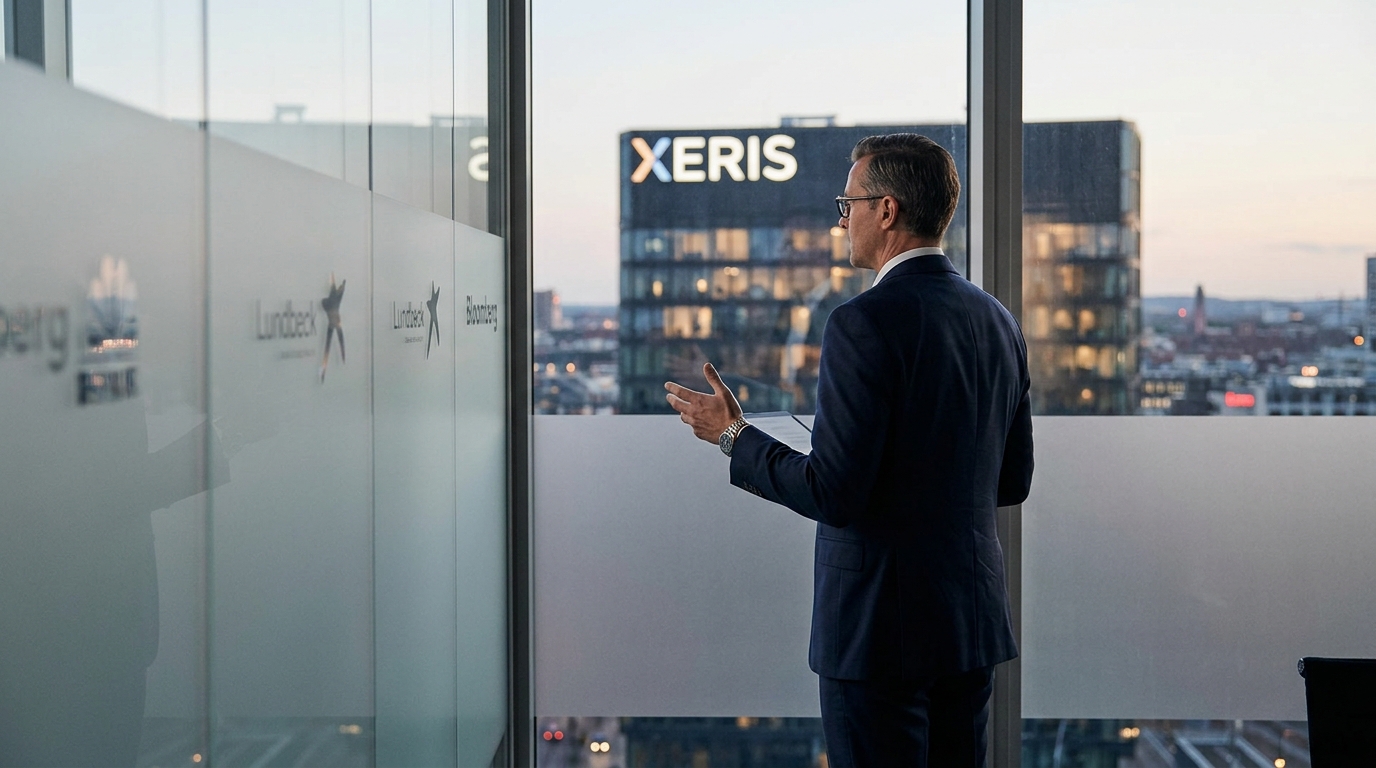
Xeris Biopharma did not ask to be a takeover target. On September 29, Bloomberg reported that H. Lundbeck, the Danish pharmaceutical group with a market capitalization of roughly $6.5 billion, has been working with advisers to explore a takeover of Chicago-based Xeris. Xeris responded quickly and without ambiguity: the company told Bloomberg it is “not for sale” and remains “laser focused” on developing and commercializing its medicines.
The stock did not care. Shares of XERS jumped on the news before giving back a portion of that move. As of October 1, the stock traded as high as $9.69 and as low as $9.18. The initial spike on September 29 took XERS to an intraday high of $11.33, its highest level in years.
The Story Behind the Trade
This is not a company Lundbeck stumbled across. The interest underscores the strategic value Lundbeck may see in Xeris’s portfolio and pipeline, particularly in the chronic endocrine and neurological therapy space. Xeris develops therapies across endocrine and rare neuromuscular conditions and has three commercially available drugs: Recorlev, Gvoke, and Keveyis.
The commercial momentum is real. In Q2 2026, Recorlev net revenue increased 81% year-over-year to approximately $57 million, lifting total revenue above $92 million. Full-year guidance stands at $385 million to $390 million. Beyond the existing drugs, XP-8121, Xeris’s once-weekly levothyroxine candidate, is expected to start its Phase 3 program later in 2026 with peak sales potential of $1 billion to $3 billion. Barclays analyst Jenna Davidner confirmed the angle: the reported M&A interest “supports our bullish thesis,” and any deal would need to come at an attractive premium to XERS’s current price.
Why Expectations May Be Lagging
Most investors are treating Xeris’s denial at face value. That is almost certainly wrong. “Not for sale” is standard language for a board that has not yet seen a number it likes, not a company that has closed the door. Discussions remain preliminary and may not result in a formal transaction, which means Lundbeck has room to return with a better offer once advisers complete their work. The consensus analyst price target sits at $12.29, with the high estimate at $18, suggesting the market is still not pricing in the possibility of a formal bid arriving above current levels.
Options Perspective
XERS implied volatility jumped on the news and remains elevated relative to the stock’s recent history, which is the expected behavior following a public M&A signal. That elevation is a double-edged reality: premium is expensive, but so is the potential payoff if an offer materializes. The structure that fits this best is a bull call spread using November expiration, which captures the period bracketing the estimated Q3 earnings date of November 5 and any potential re-engagement from Lundbeck. A spread between the $10 and $12.50 strikes defines the maximum loss to the net debit paid while keeping meaningful upside if the stock moves toward a formal bid. The $12.29 average analyst target sits comfortably inside that range.
The position benefits from continued deal talk or any formal approach. It is largely neutral to the denial already on record, since the denial itself was the catalyst that kept IV bid. Time decay works against the trade if the deal talk goes quiet, and a sharp drop in volatility following a definitive no-deal statement would pressure the long call faster than the short leg recovers it.
Risk Management
Lundbeck walks away. That is the primary risk, and it is real. There is no guarantee the interest will result in a deal. A clean withdrawal would take both the deal premium and the elevated implied volatility out of the stock simultaneously, compressing the spread from both directions. Keep position size small. The defined-risk structure handles the downside math, but sizing should reflect that this is a binary catalyst trade dressed in moderate-looking premium.
The Beast Verdict
Lundbeck retained advisers before Bloomberg ran the story. Companies do not pay advisory fees to test the waters on companies they plan to abandon after a single press denial. The Q3 earnings report on November 5 adds a second potential catalyst inside the same expiration window, with Recorlev’s growth trajectory likely to reinforce exactly the valuation argument a bidder would make. The bull call spread on XERS captures both without requiring conviction on the outcome. The premium you risk is what the trade costs. The potential reward is a stock that moves toward $12 to $14 on a formal offer. Watch for any SEC filings disclosing Lundbeck’s ownership and for any board response that softens the tone of the initial denial.