
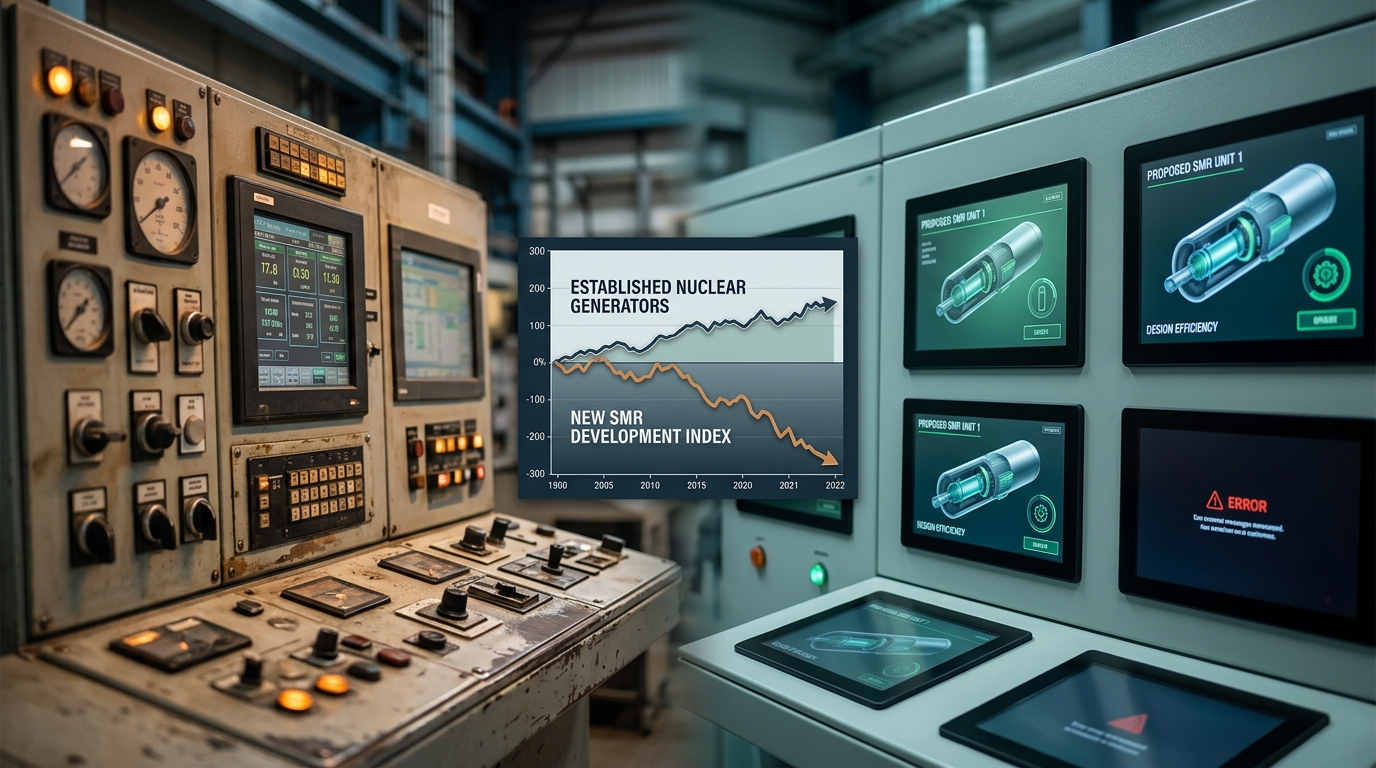
Two pieces of nuclear news landed within 48 hours of each other this week. They tell investors something the sector has been avoiding saying directly: the nuclear power trade has split in two, and the split is permanent enough that institutional money is being forced to pick a side.
The Big Question
Is the AI nuclear investment thesis about power that exists, or power that is being promised? Google answered for itself on September 9, 2026. UBS answered for NuScale on September 11, 2026. The two answers point in opposite directions.
Why Wall Street Cares
A deal between Google and Nordic utility Fortum will help unlock roughly €1 billion of investment needed to keep a nuclear power plant in Finland running for decades to come. As part of a €13 billion AI infrastructure plan in Finland, Google agreed to buy up to 50% of the capacity from the Loviisa nuclear power plant, supporting the plant’s operation through 2050. Meanwhile, NuScale Power plunged about 13% on September 11 after UBS downgraded the stock to Sell from Neutral and slashed its 12-month price target to $6 from $10, a move implying roughly 40% downside.
The timing was not coincidental. It was clarifying.
The Bull Case for Existing Nuclear
Fortum said the Loviisa plant could not continue operating beyond 2030 without the investment program, and the Google agreement provides revenue certainty for that work, keeping the plant operating through 2050. That certainty is precisely what the market values. Fortum shares surged about 10% on the announcement.
Loviisa extends a pattern in which big tech companies become anchor tenants of nuclear plants and nuclear restarts: Microsoft signed a long-term agreement tied to Constellation’s plan to restart Three Mile Island Unit 1, and Google signed a 25-year deal with NextEra for the Duane Arnold plant in Iowa, and now Google has exported the model to Europe. Constellation Energy and Vistra are competing to capitalize on rising demand for nuclear power driven by AI data centers, both leveraging nuclear assets while expanding natural gas capacity. Constellation signed about 920 megawatts of long-term nuclear power purchase agreements in Q2 alone, including Walmart’s first-ever nuclear deal. These are contracted megawatts from reactors already generating electrons. The investment committee argument writes itself.
The Bear Case for Promised Nuclear
UBS grounded its bearish thesis on NuScale in three interlocking failures: a construction timeline extending more than five years, the absence of firm customer commitments, and projected cash consumption of approximately $700 million from 2026 through 2028. UBS warned that project delays, setbacks with RoPower, and limited progress with the Tennessee Valley Authority could expose the gap between market expectations and the firm’s more conservative projections.
The valuation math is brutal. At the current stock price, UBS estimates the market implies $124 million of 2028 EBITDA, compared to its own forecast of $29 million. Other analysts tracked by S&P Global Market Intelligence have also modeled substantially higher cash burn than UBS over the 2026 to 2028 window. UBS said NuScale’s path to secure firm customer orders is increasingly difficult as peers make tangible commercial progress with competing designs.
What Investors Are Missing
The Oklo reaction deserves attention. Oklo stock eased only modestly in sympathy, and that smaller decline reflects UBS’s relative argument: competing SMR developers may reach the construction stage sooner than NuScale, concentrating pressure at the NuScale name inside a group otherwise closer to unchanged. In August, Oklo announced first criticality at its Groves Isotope Test Reactor in Texas, meaning the reactor achieved a controlled, self-sustaining nuclear chain reaction at low power. Oklo has also talked about data-center power interest under non-binding letters of intent. These are still letters of intent, not signed contracts, and Oklo remains pre-revenue. But the milestone gap between Oklo and NuScale is widening in Oklo’s favor, which is exactly what UBS said.
The deeper point is that Google’s Finnish deal reframes the entire AI power conversation. Hyperscalers are not waiting for SMRs. They are signing contracts today for reactors that already run.
Stocks to Watch
Google (GOOGL): Ruth Porat framed the energy component as structural rather than incidental, calling the Loviisa agreement “a really important cornerstone to everything that we are doing” in Finland. A 22-year nuclear contract for an AI infrastructure program worth €13 billion is not an energy trade. It is a competitive moat.
Constellation Energy (CEG) and Vistra (VST): Both are running the same playbook: leaning on nuclear as the crown-jewel asset for the AI data center build-out while simultaneously bulking up on natural gas to add flexible capacity faster than new nuclear could ever be built. The Google-Fortum deal validates that playbook globally, not just in the U.S.
NuScale (SMR): Ten of the 18 brokerages covering the stock still hold neutral ratings, suggesting more downgrades could follow. Shares are already down 28% in 2026. The path to recovery requires a binding customer commitment. Until that arrives, the stock is a speculation on a timeline UBS now publicly doubts.
Oklo (OKLO): Oklo’s execution around the Aurora reactor at Idaho National Laboratory, plus first criticality at its Groves test reactor facility in early August, gives it a separate story from the NuScale file. It is still a pre-revenue bet, but it is the SMR bet institutional money is less aggressively leaving.