
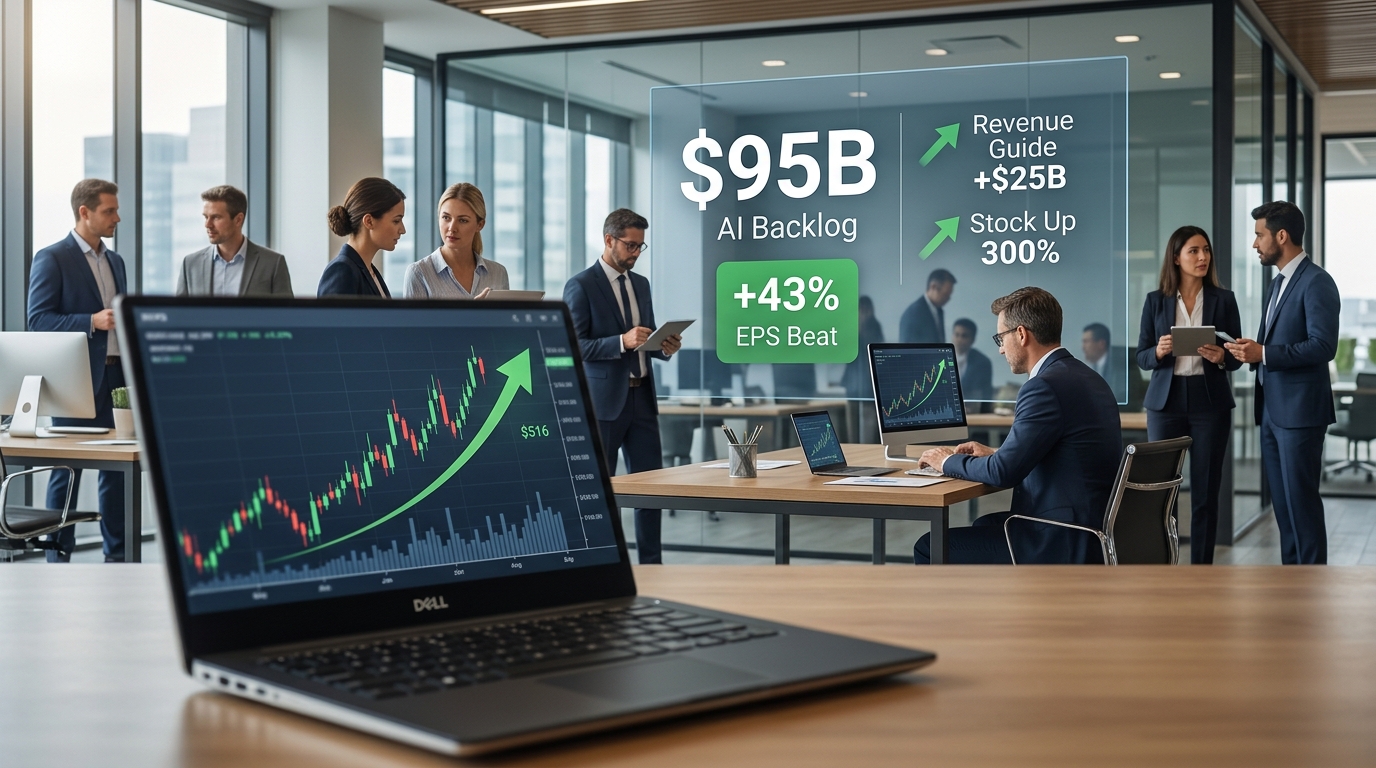
Dell Technologies delivered its fiscal second quarter on September 1, and the numbers were not close. Revenue came in at $46.97 billion, up 58% year over year and well above the roughly $44.9 billion Street consensus. Adjusted EPS hit $7.04, beating the $4.91 estimate by 43%. The stock jumped 15.8% on September 2 and added another 4.8% on September 3, closing near $516.
The business doing the work is the Infrastructure Solutions Group. ISG posted record revenue of $31.8 billion, up 89%, while AI server revenue reached $16.4 billion as Dell booked a record $60.9 billion in AI orders and closed the quarter with a record $95 billion AI backlog. That backlog figure deserves a moment. It is not revenue already recognized. It is work already won, sitting in the queue.
The Business
Dell is one of the largest independent AI server builders in the world. When hyperscalers and enterprise buyers want GPU-dense racks built, configured, and shipped at scale, Dell is one of a handful of companies that can actually do it. Its AI infrastructure customer count has now grown past 6,500, spanning neocloud operators, sovereign government deployments, and traditional enterprise buyers. The military is in that mix too. Earlier this year, the Pentagon awarded Dell Federal Systems a five-year agreement valued at about $9.7 billion tied to consolidating Microsoft software and licenses across the Department of Defense.
Management raised full-year revenue guidance by $25 billion to $192 billion and now expects adjusted EPS of $25.50, up approximately 150% year over year. Dell also expects $74 billion in AI-optimized server revenue for the fiscal year, representing roughly 3x growth.
Why Wall Street Is Paying Attention
Analysts scrambled. JPMorgan raised its target to $635. Raymond James went to $617. Evercore ISI lifted to $575. Morgan Stanley, Goldman Sachs, and Citigroup also raised their price targets. The consensus view is that Dell’s end-to-end positioning, from server assembly through storage and services, gives it structural advantages that Nvidia-only plays do not have.
Dell’s AI-optimized server revenue of $16.4 billion topped the roughly $16.1 billion consensus. Traditional server and networking revenue jumped 122% to about $10.5 billion, while storage revenue increased 26% to about $4.9 billion. Every line grew. The quarter was not carried by one product.
What Could Go Wrong
The valuation question is real. Dell’s roughly 295% year-to-date run shifts the real question from whether AI server demand is real to how much opportunity is already priced into the stock. At roughly $516, the forward multiple sits near 20x on the new $25.50 EPS guidance, which is not cheap for a hardware builder whose gross margins remain structurally thin.
Free cash flow fell 47% amid inventory builds, and the bear scenario lands at $480 if a major hyperscaler pauses spending. CEO Jeff Clarke has acknowledged that AI server fulfillment is nonlinear: shipments are lumpy, and delivery depends on data center construction and power availability. A single large customer deferral could skew a quarter badly. The memory cost problem is real too. TrendForce projected server DRAM contract prices would rise 13% to 18% sequentially in Q3 2026, which compresses margins on each system shipped.
The Bottom Line
Dell is not a speculative AI bet. It is a company generating tens of billions in real revenue from real customers who are building real infrastructure. The $95 billion backlog gives visibility that most hardware companies would kill for. Management raised its full-year revenue guidance by $25 billion to $192 billion and now expects diluted non-GAAP EPS of approximately $25.50. That is a guidance raise with conviction behind it.
The risk is not the business. It is the price. Investors who missed the first 300% gain face a different risk-reward than those who have held all year. The case for buying here rests on whether the AI backlog converts at the margins management has guided. If it does, the stock has room. If a hyperscaler pauses or memory costs accelerate, the downside is swift. Dell earns its position at the top of the AI infrastructure trade. The question every new buyer must answer is whether the price reflects the backlog or the upside beyond it.