
Hey there, bargain hunter.
On June 1, a company almost nobody outside of enterprise software circles had heard of three years ago quietly submitted paperwork that could reshape the entire public market for artificial intelligence.
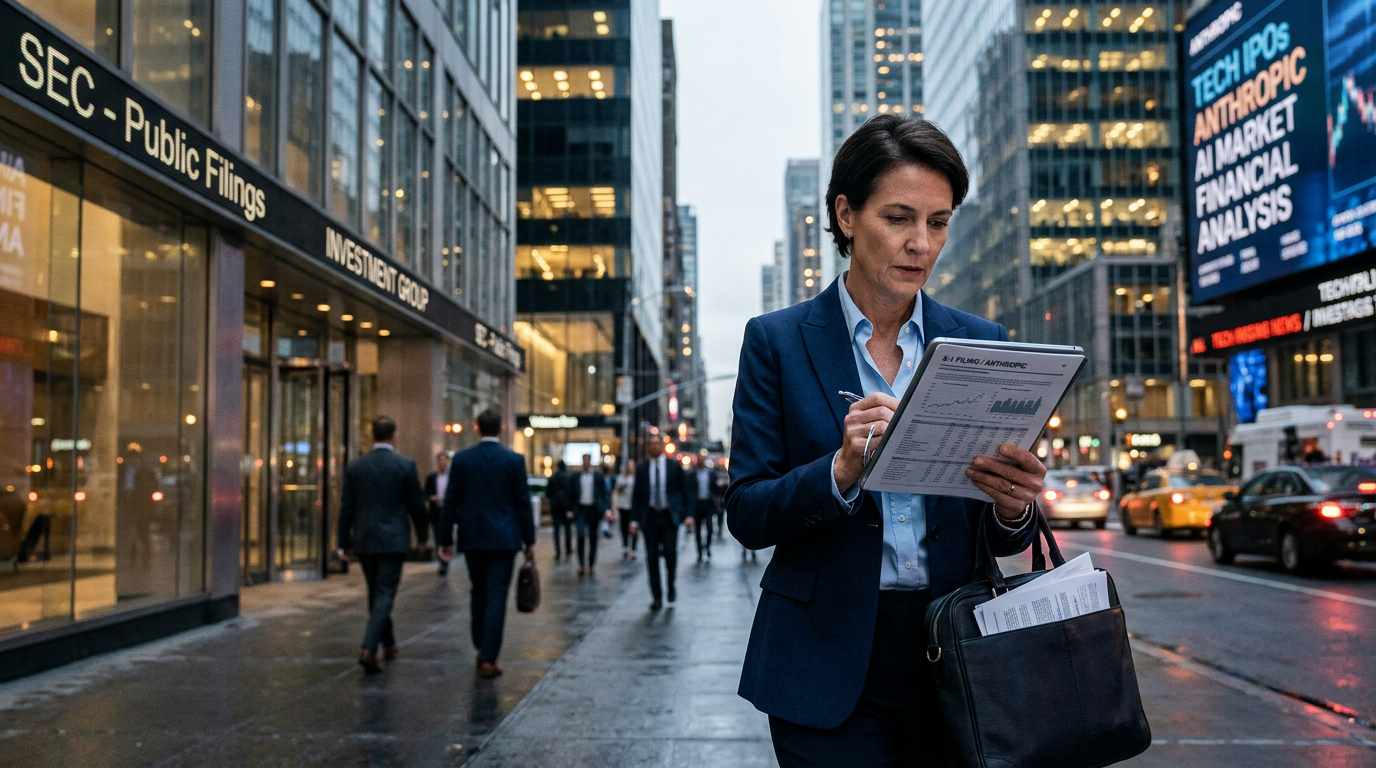
Anthropic filed a confidential S-1 with the SEC.
Let that sink in for a second. A company that didn’t exist before 2021 is now knocking on the door of a public listing at nearly a trillion dollars in valuation. Not billion. Trillion.
What Actually Happened
Here is the sequence of events, compressed: Anthropic raised $65 billion in a Series H round at a $965 billion post-money valuation in late May. Days later, it submitted its confidential S-1 to the SEC on June 1, 2026, becoming the first major frontier AI lab to formally begin the IPO process. No share price, no share count, no listing date has been set. The timing and structure of any offering remains dependent on market conditions.
But the intent is clear. And the race is officially on.
OpenAI confidentially filed around May 22 and is targeting a potential September 2026 debut at a $1 trillion-plus valuation. SpaceX has already filed its public S-1 and was targeting a June 12 Nasdaq listing under ticker SPCX. Goldman Sachs projects 2026 could set a new record for total U.S. IPO proceeds, potentially exceeding $160 billion, topping the 2021 record of $156 billion.
Three companies. Combined implied valuation somewhere north of $3.5 trillion. All going public within roughly six months of each other.
The Business Behind the Filing
Anthropic builds and operates the Claude family of large language models. The core monetization engine is API usage and enterprise subscriptions, with Claude increasingly adopted for coding and agentic workflows. That is not a minor market. Revenue run-rate crossed $47 billion annualized in May 2026, up from a reported $10 billion target entering 2025. That is 4.7x growth in roughly twelve months.
For context: OpenAI, which has a four-year head start and arguably the most recognized AI brand on the planet, was at approximately $25 billion in annualized revenue as of February 2026. Anthropic is growing faster and, on a revenue-multiple basis, is priced more cheaply. At $965 billion against roughly $47 billion in run-rate revenue, that is approximately 20x forward revenue. OpenAI trades at closer to 34x on the same metric.
That relative discount is probably the most interesting number in the entire AI IPO wave right now.
The Part People Keep Skipping
Anthropic is not profitable. And it is not framing that as a temporary condition. Projected losses run approximately $11 billion in both 2026 and 2027. At $47 billion in run-rate revenue, that works out to roughly a 23% loss margin. The company has committed to spend at least $86 billion on model training through 2029 alone, a figure that does not even include inference compute costs, which scale directly with usage.
The path to positive free cash flow is targeted for 2027, which would be three years ahead of OpenAI’s own breakeven forecast. Whether that holds is the central bet investors have to make.
There is also a structural wrinkle. Anthropic is a Public Benefit Corporation, meaning its corporate charter legally incorporates obligations beyond shareholder returns. How a public company balances that with quarterly earnings pressure is an open question that will likely dominate the roadshow conversation.
And one more thing: in February 2026, the U.S. Department of War added Anthropic to its supply chain risk list and banned federal contractors from using its services after the company refused to allow Claude to be used for mass surveillance and autonomous weaponry. Seven competitors, including OpenAI, received Pentagon authorization. That distinction cuts both ways with investors. A compliance signal for enterprise clients with ethical procurement mandates. A commercial ceiling for government contract revenue.
The Capital Flow Problem Nobody Is Talking About
Here is what most retail investors are missing entirely. Money rotating into SpaceX, OpenAI, and Anthropic has to come from somewhere. The most likely source is existing Magnificent 7 positions. Even investors who never touch a single IPO share could feel this as a headwind in positions they already hold, particularly the hyperscalers and semiconductor names that have dominated portfolios for three years.
This is not theoretical. It is math. The largest passive-liquidity demand event the public markets have ever seen is arriving in a compressed window. The second-order effects on existing large-cap tech valuations deserve more attention than they are getting.
Bull, Base, Bear
Bull: Anthropic’s revenue continues compounding at current pace, gross margins expand as compute costs deflate, and the enterprise software moat widens. A $1.1 trillion first-day market cap, per one forecast model, is achievable. Dan Ives of Wedbush has called the $965 billion valuation “just the tip of the spear” for the broader AI investment cycle.
Base: Growth remains strong but decelerates as competition from OpenAI, Google DeepMind, and open-source models intensifies. The stock prices at valuation but doesn’t compound from it for 12 to 18 months post-listing.
Bear: SEC review forces a gross-to-net revenue restatement. Per one detailed forecast model, if that happens, headline ARR could drop 20% to 40% in one disclosure, and the multiple math that institutions are currently carrying breaks apart. The downside scenario is not theoretical. It is a real risk embedded in the confidential filing process.
What You Can Actually Do Right Now
Most retail investors cannot access this before the listing. Pre-IPO exposure is largely limited to accredited investors via secondary markets, employee tender offers, or late-stage venture funds with high minimums and limited liquidity.
What you can do is map the beneficiaries. Amazon and Alphabet are both strategic investors and primary compute providers for Anthropic. Multi-gigawatt cloud agreements with both companies mean any Anthropic revenue growth translates directly into cloud consumption on AWS and Google Cloud. That is a less obvious, more liquid way to express a view on Anthropic’s trajectory right now.
The public S-1, when it comes, will be the most important financial disclosure document in the AI industry’s history. It will contain audited financials, gross margins, retention data, and compute cost structures that nobody outside Anthropic and its investors has ever seen. When that lands, the conversation around AI valuations across the entire sector will likely reprice. In one direction or another.
Worth watching closely.