
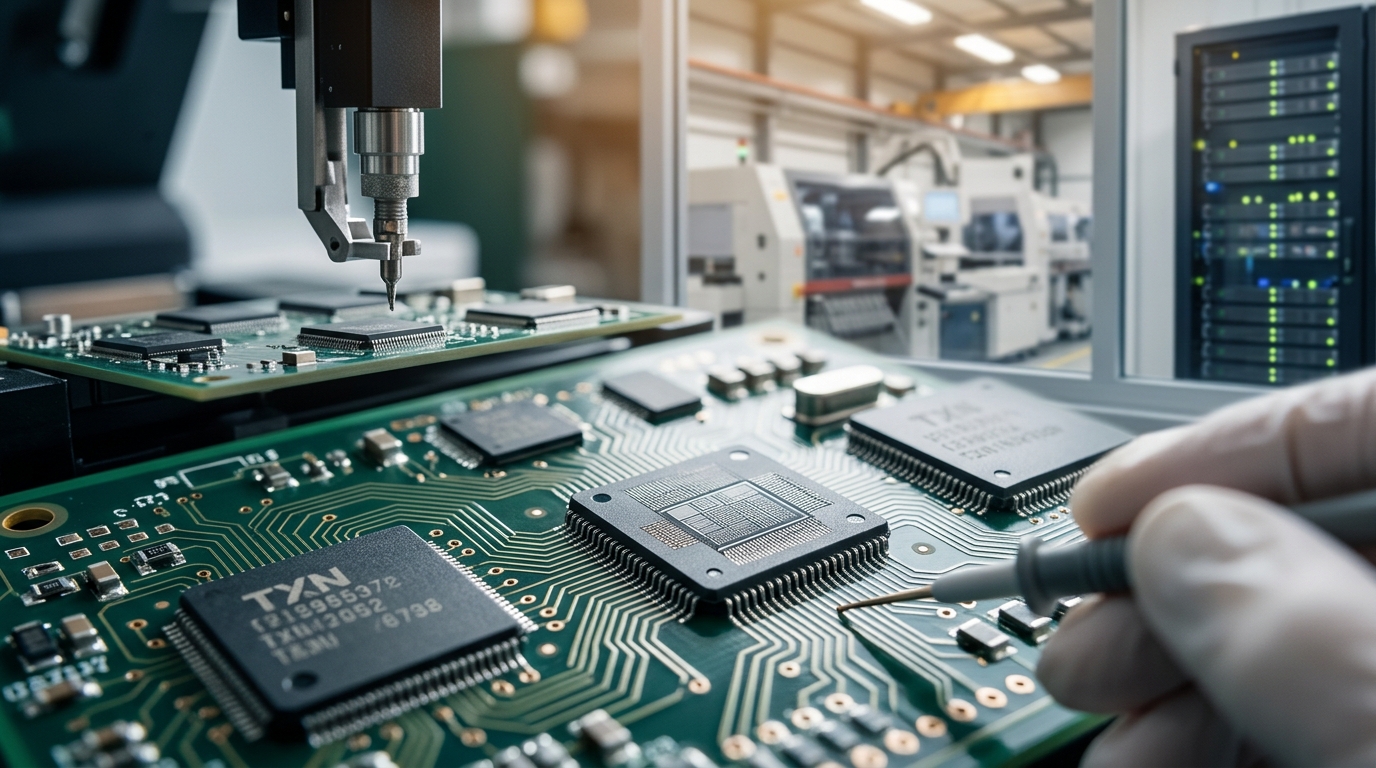
Texas Instruments (NASDAQ: TXN) makes none of the AI chips that dominate the headlines. No GPUs. No custom AI processors. No HBM memory.
The stock is up roughly mid-60% year-to-date anyway.
TI makes none of the AI compute chips everyone talks about, like Nvidia’s GPUs and Broadcom’s custom chips. Instead, it builds analog and embedded processing chips: power management ICs, voltage regulators, and amplifiers, the unglamorous components that keep electronics running. For decades that made TI a boring cyclical. That is changing fast.
The Two-Engine Story
Every AI server needs more than just GPUs, memory, and networking. It also requires a network of analog chips that convert, regulate, and monitor electricity, synchronize high-speed data flowing between processors and memory, and ensure the system operates reliably under heavy workloads. Without these components, the GPUs cannot be powered or communicate efficiently. As AI servers become larger and more power-intensive, the amount of analog content per server continues to increase.
TI has built the largest data center business in the analog semiconductor industry, generating approximately $1.5 billion in revenue in calendar 2025, up 64% year over year. Growth accelerated further in the first quarter of 2026, with data center growth about 90% year over year. That is not a one-quarter print. That is a structural shift in what AI factories need to run.
The second engine is industrial. Customers had over-ordered chips during the pandemic and spent 2023 and 2024 burning through that excess rather than placing new orders. Now that industrial demand is recovering and data center demand is surging, factory utilization is rising, and margins should follow. The industrial recovery, which CEO Haviv Ilan called early-stage, is still 15% below its prior peak. That means the runway here is not used up.
Q2 Heading Into July 22
Texas Instruments is likely to beat earnings estimates when it releases its second-quarter 2026 results on July 22. The company anticipates revenues between $5 billion and $5.4 billion for the second quarter.
The consensus mark for earnings is pinned at $1.91 per share, implying growth of 35.5% from the year-ago period. The consensus has been revised upward over the past seven days. Upward revisions heading into an earnings report are a tell. Analysts are not usually more optimistic right before numbers that disappoint.
TXN has beaten revenue in three of the last four quarters, and Q1 2026 delivered an EPS surprise of roughly the low-to-mid 20% range. The bar is high. But the data flowing into the quarter supports it.
Stifel cited year-to-date SIA/WSTS billings data showing general purpose analog up 22% year-over-year, where the company is most heavily weighted. Embedded products are also recovering, with microcontrollers up 17% year-over-year. June ISM data shows the manufacturing PMI held at 53.3% for the sixth straight month of expansion. New Orders remained expansionary at 56.0%, and customers’ inventories at 42.3% remained too low, which is typically a positive indicator for future production.
The Cash Flow Story Nobody Is Talking About
Trailing twelve-month free cash flow reached about $4.4 billion, up from about $1.7 billion in the first quarter of 2025. That is not a rounding error. That is the manufacturing investment cycle finally harvesting returns after years of heavy spending.
The company has provided a range for 2026 free cash flow per share of approximately $8 to $12, with the upper end anchored to revenue reaching $26 billion. The company has also demonstrated shareholder-friendly capital allocation, having raised its dividend for 22 consecutive years.
The Bull and Bear Case in Two Sentences Each
Bull: Bank of America projects that TI’s data center revenue could reach roughly $4.5 billion by 2028, or about 18% of company sales. TI is benefiting from two growth engines at once: an industrial recovery that appears to have genuine runway left and a structural AI infrastructure build-out that increases analog content per server.
Bear: At around 35 times forward earnings, Texas Instruments is trading at a meaningful premium to its historical average, leaving limited room for error if the industrial recovery stalls, automotive demand in China continues to soften, or the $7.5 billion Silicon Labs acquisition introduces integration complexity at a sensitive moment in the cycle.
What July 22 Actually Decides
Two numbers will settle the debate. Watch data center growth above all. Holding near last quarter’s ~90% pace confirms the share-gain story. A meaningful slowdown is the first crack, and after the year’s run, the stock has room to fall toward the Street’s average. Watch industrial too: a second straight quarter of broad sequential growth turns a hopeful recovery into a confirmed one.
One more thing. Texas Instruments announced that Julie Knecht will take over as the new chief financial officer effective August 1, 2026, succeeding Rafael Lizardi, who plans to retire at the end of August 2026. Leadership transitions at this stage of a cycle are worth watching. Q2 guidance language will carry extra weight because it will be the last set of comments from the outgoing CFO.
TXN is not a story about hype. It is a story about what happens when a company spends six years building manufacturing capacity and then the cycle finally turns in its favor at the same time AI drives structural demand for the exact chips it makes. That combination does not come around often. July 22 tells us how far along the recovery actually is.
For informational purposes only.