
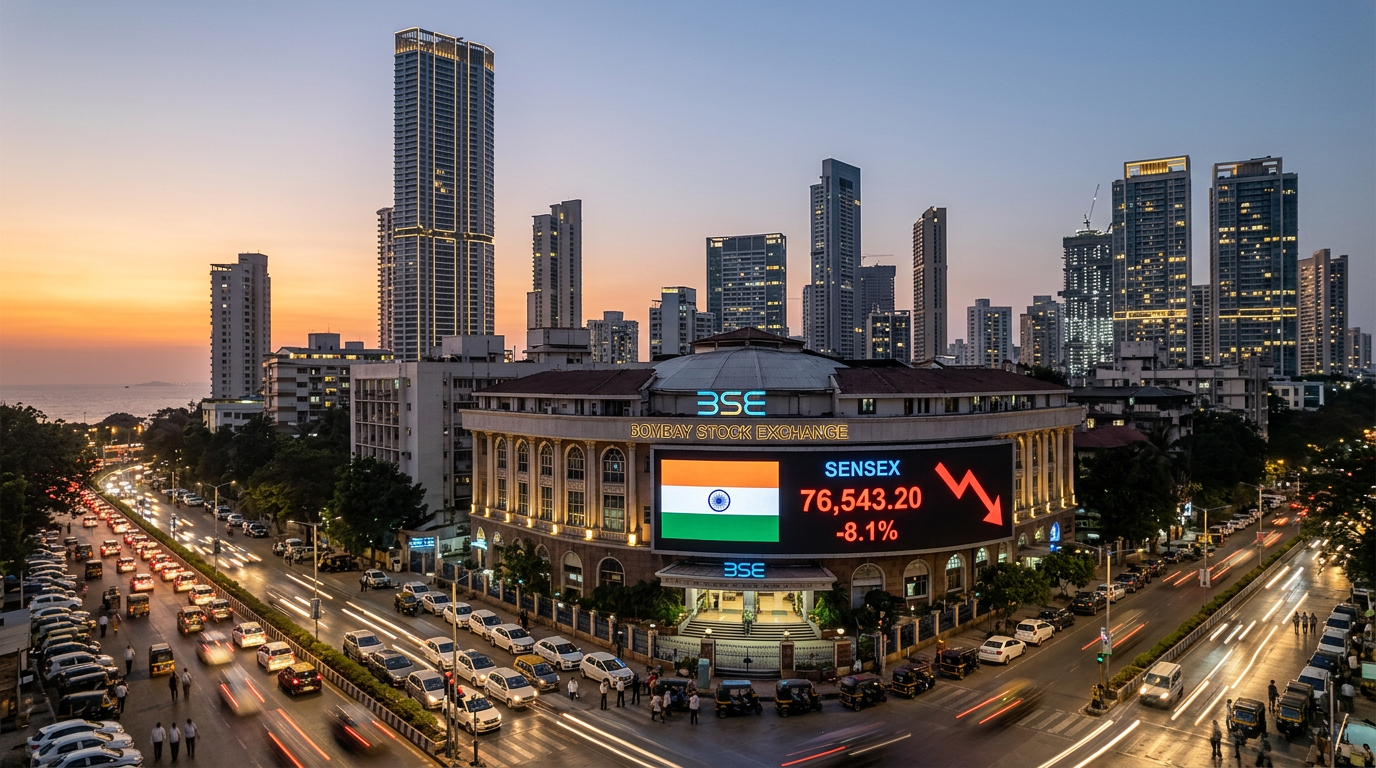
India’s GDP grew 7.7% in fiscal year 2026. Q4 came in at 7.8%. The government’s own projections at the start of the year were 6.3% to 6.8%. The country beat every external estimate, outpaced every other G20 economy, and did it while absorbing a wave of U.S. tariffs, elevated energy costs from the Middle East conflict, and record foreign portfolio outflows early in the year.
And the Sensex is sitting roughly 8% below where it was a year ago.
That gap — between what the economy is doing and what the stock market is pricing — is the story most investors outside India haven’t noticed yet.
What’s interesting is how this divergence happened. The Nifty 50 hit a peak near 26,373 in early January 2026 and has spent most of the year pulling back despite improving fundamentals. FII (foreign institutional investor) outflows ran persistently negative through much of the first half. The rupee weakened. Global risk-off sentiment hit India harder than its economic data warranted. That’s not unusual — it happens in emerging markets when fear is the dominant driver. But it creates an opening for investors who separate the short-term flow story from the long-term structural one.
The structural case is not complicated. India is now formally the fastest-growing G20 economy after MoSPI’s official data revision. Private expenditure accelerated to 7.7% growth versus 5.8% in the prior year. Gross fixed capital formation — the capex number — came in at 7.1%. Domestic consumption, which accounts for nearly 70% of GDP, is driving the bulk of the expansion. This is not export-led growth that’s vulnerable to a global slowdown. It’s a domestic engine.
The rating agencies noticed. S&P upgraded India’s sovereign rating from BBB- to BBB in August 2025 — its first such move in 18 years. Deloitte projected GDP at 7.5% to 7.8% for FY26 and flagged resilient domestic demand as the primary driver even amid trade friction. The actual number landed at the top of that range.
Here’s where it gets interesting on the policy side. India concluded negotiations on a comprehensive Free Trade Agreement with the European Union — a deal that covers a combined market worth roughly $24 trillion and gives preferential access to over 99% of India’s exports by trade value. That’s not a minor footnote. It’s a structural shift in how Indian goods reach the world’s largest trading bloc. Separately, FTA negotiations are now underway with the GCC, Israel, and with the U.S. deal still pending but potentially close.
The RBI, meanwhile, signaled this week that it sees rate hikes as premature — introducing liquidity support measures while keeping rates steady. That’s a meaningful distinction. In an environment where the Fed is still navigating above-target inflation, the RBI is leaning toward accommodation. Easing credit conditions combined with 7%+ GDP growth is a macro combination that investors in developed markets almost never get to buy.
The sectors worth watching aren’t the obvious ones. Banking was the standout performer in the most recent session — ICICI Bank, SBI, HDFC Bank, Kotak Mahindra all moved higher after the RBI expanded loan options against foreign currency deposits. Financials benefit directly from falling non-performing loan ratios (Indian banks cleaned up their balance sheets aggressively over the past three years), improving net interest margins, and rising credit penetration in a country where vast portions of the population still lack formal banking access.
Autos are the other angle. Mahindra and Maruti were among the top gainers this week — no coincidence. GST reform cut auto tax rates by 5% to 10% across categories, stimulating demand particularly from first-time buyers and premium two-wheeler segments. When you reduce the effective price of a product in a market with 1.4 billion people and a still-low vehicle ownership rate, the demand response can run for years, not quarters.
IT is the risk. TCS has lost over 38% in the past year — the worst performer in the Nifty 50 over that period. The global enterprise software slowdown is hitting Indian IT services companies harder than the broader economy. That creates a potential drag on any broad India index position, and it’s worth understanding before buying a diversified India ETF.
The easy vehicle for U.S. investors is INDA (the iShares MSCI India ETF) or SMIN for small-cap exposure. Neither is perfect. INDA is heavily weighted toward financials and energy. SMIN gives exposure to domestic consumption stories that are harder to access through large-cap indexes but comes with higher volatility and wider spreads.
The FII outflow story may be turning. The Sensex rose 0.4% for the week ending June 25, with India VIX falling to 13.05 — a multi-week low. Crude oil pulled back as U.S.-Iran talks showed progress, relieving pressure on India’s import bill. That’s a meaningful tailwind for a country that imports the bulk of its energy. Every $10 decline in oil is roughly $15 billion in annual savings for India’s current account.
None of this resolves the tension between the valuation picture and the earnings reality. Some pockets of the Indian market — particularly midcap tech and consumer discretionary — are not cheap by any historical measure. The S&P upgrade, the FTA progress, and the 7.7% GDP print don’t automatically justify stretched multiples in every corner of the market.
But the broader index, down nearly 8% from its high in a country posting its best growth rate in four years, is not the kind of setup that usually persists. At some point, the FII outflows reverse. When they do, the move tends to be fast.
Worth a look before that happens.