
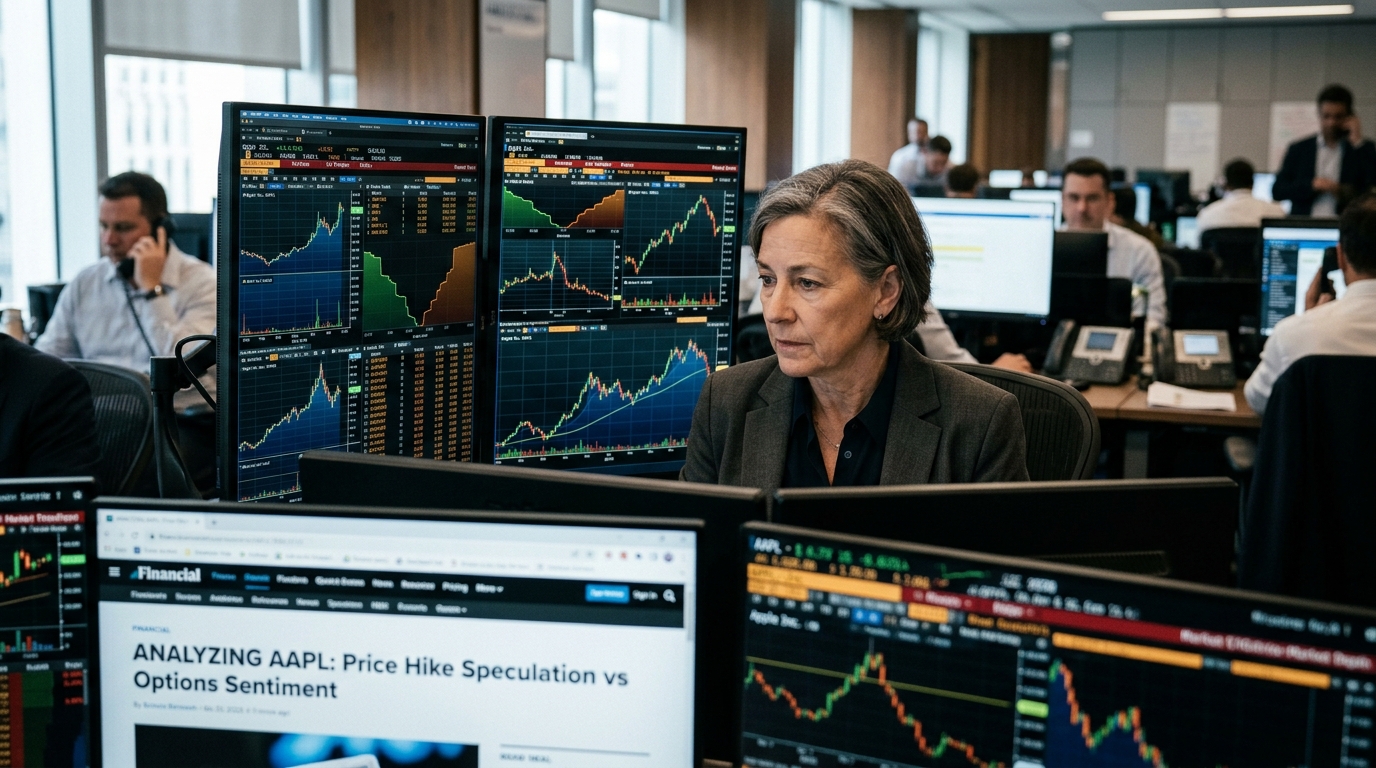
Slight tangent to open, because it matters: Apple hit an all-time intraday high of $317.40 on June 8, 2026 — the day WWDC kicked off. By the time Tim Cook finished the keynote on June 8, the stock was down about 1.9% on the day.
That’s the WWDC hangover. And it’s the context for everything that happened today.
On June 17, Cook told The Wall Street Journal that Apple is likely to raise prices as higher memory costs increasingly pressure the business. Apple had also previously warned investors it expected “significantly higher memory costs” in the June quarter and beyond. The price is telling you something.
The Price Hike: What It Is, What It Isn’t
Let’s be precise about what Cook actually said. Apple has been facing significantly higher memory costs, and Cook has indicated those rising inputs are expected to have a growing impact — a dynamic that can ultimately force pricing changes. The core point is that higher memory costs are becoming harder to absorb indefinitely.
This is a margin preservation move, not a demand signal. Apple is not raising prices because demand is outrunning supply. It’s raising prices because input costs have risen faster than the company’s ability to offset them through operational efficiencies. For options traders, the distinction matters.
Higher prices on consumer hardware introduce a real demand risk heading into the holiday product cycle. If Micron and other memory suppliers’ pricing power is the cause, and Apple is a major buyer of NAND and DRAM components, then the margin pressure was always structural — the price hike is confirmation, not surprise.
Post-WWDC: The AI Story Is Still Being Written
Apple unveiled “Siri AI” at WWDC 2026 — a revamped Siri positioned as more conversational and more capable across Apple’s platforms. Reporting around WWDC also pointed to Google/Gemini playing a role in Apple’s broader AI foundation-model efforts. The new macOS release, “Golden Gate,” introduced refinements, including updates tied to Apple’s “Liquid Glass” design language. The market’s initial reaction was lukewarm at best.
Part of that response was driven by the OpenAI situation. Apple has discussed expanding how Siri can route certain queries to third-party models, including ChatGPT, but specific claims of a failed ChatGPT integration escalating into legal action ahead of WWDC could not be verified. What is verifiable is that the keynote didn’t fully erase the broader “AI laggard” skepticism in one day.
Morgan Stanley had framed WWDC as a potential re-rating event ahead of the conference — a moment that could reframe Apple as an “AI winner” with valuation moving toward $365-$385, and upside to $440. Bank of America raised its price target to $380, citing Apple’s potential to generate between $15 billion and $30 billion in AI-related revenue by fiscal 2030.
Neither of those targets looks imminent at $296.
What’s actually interesting is how the market is processing this. Apple’s fiscal Q2 2026 revenue came in at about $111.2 billion — up 16.6% year over year — with EPS of $2.01. The company is not struggling operationally. The stock’s drift off its all-time high is a sentiment and multiple compression story, not a fundamentals story. That’s an important distinction.
The Options Picture Going Into Q3 Earnings
AAPL options have historically been among the most liquid in the market, with tight bid-ask spreads and deep open interest across expirations. The current trading environment reflects what you’d expect from a stock sitting below a recent all-time high with a product catalyst already digested and the next big event — Q3 earnings — sitting several weeks out.
Recent options flow showed balanced positioning with a modest tilt toward calls — the kind of positioning that doesn’t commit strongly in either direction. That’s consistent with a market that isn’t sure whether the price hike messaging is margin-positive news or a demand-risk signal. The ambiguity is real.
What the options market is pricing is a stock that has absorbed a major catalyst (WWDC), a CEO pricing signal (today), and an approaching earnings event without breaking down through key support. The $295-$300 zone has held. That’s not nothing.
Three Frameworks for AAPL Positioning Right Now
Bull case — for traders expecting the price hike to expand margins and the AI platform to gain traction through the fall product cycle: A defined-risk call spread targeting recovery toward the $310-$320 zone, expiring after Q3 earnings, captures upside if the multiple re-expansion trade triggers. Apple’s roughly 50%+ one-year return and strong institutional ownership (Vanguard and BlackRock collectively hold significant positions) suggests dip-buyers remain active.
Bear case — for traders concerned that price hikes dampen hardware demand and the AI story has already peaked in market expectations: The GF Value fair value estimate puts AAPL at $265.42 against a current price near $296 — an 11.5% premium by that metric. Insider activity has shown $111.7 million in shares sold over the past three months. A defined-risk put spread targeting $280-$275, positioned ahead of Q3 results, expresses a view that multiple compression has further to run. The bear case requires patience — AAPL rarely gaps violently lower without a hard earnings miss.
Neutral case — for traders expecting the stock to chop between the post-WWDC base and prior all-time highs: An iron condor positioned between roughly $275 and $320 through July expiration collects premium in what has been a range-bound environment since WWDC. The key risk to this structure is a sharp earnings surprise or an unexpected AI announcement that breaks the range in either direction.
The Part Most Traders Are Glossing Over
Apple’s Q3 earnings — covering the June quarter — will be the first report to include any signal from the post-WWDC product cycle and whatever demand behavior emerges from the price hike decision. Services revenue continues to grow and carries meaningfully higher margins than hardware. If Apple can demonstrate that services growth is accelerating while hardware margins stabilize from the price hike, the re-rating thesis lives.
If Q3 shows hardware weakness alongside margin pressure that the price increase hasn’t yet offset — that’s a different conversation entirely.
The stock is near $300 for a reason. It’s at the intersection of an all-time-high hangover, a CEO-confirmed cost push, and an AI platform launch that the market hasn’t fully priced as either positive or negative. That ambiguity tends to resolve on earnings day, not before.
Worth staying close to the $295 support. That level matters more than the headline does right now.